


 CDN NEWS |
  US NEWS







Octopus Energy Generation will spend up to $6 billion to build and operate renewable energy park

Waste biomass from Nova Scotia forestry and forest-base industries will be used to create low-emission aviation fuel at the Nova Sustainable Fuels project in Goldboro, N.S. Photo by Province of Nova Scotia
A European energy giant will spend as much as $6 billion to build and operate a renewable energy park in Nova Scotia.
Octopus Energy Generation Ltd. plans to use biomass – such as branches, bark and unused timber – from forest-based industries to produce sustainable aviation fuel (SAF) it will sell to European customers.
The processing for Nova Sustainable Fuels, as the Canadian subsidiary is known, will be done at a to-be-constructed renewable energy park in Goldboro, N.S. The site, estimated to cost between $4 billion and $6 billion, is expected to take about three years to build and have a 50-year lifespan.
“They put the project through a significant vetting process to decide if this was something that they wanted to take on,” said Andrew Parsons, project director.
“When you see the massive amount of money that needs to be spent before you reach an investment decision and then, subsequent to that, the billions of dollars necessary to construct and operate the facility, that is a very, very strong sign of confidence and a really solid foundation for the project.”
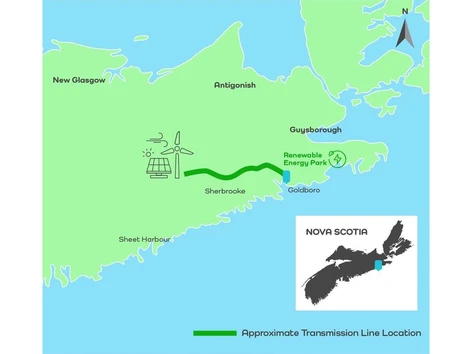
A map of the multi-billion-dollar renewable energy megaproject planned for Nova Scotia’s Eastern Shore that would produce sustainable aviation fuel from forestry biomass. Photo by Nova Sustainable Fuels
With airlines seeking to decarbonize, the World Economic Forum reported in 2025 that the global demand for SAF is projected to grow exponentially, reaching 17 million tonnes annually by 2030. That represents four to five per cent of total jet fuel consumption.
Parsons said the foundation of the project is based on supplying SAF to European markets.
As of Jan. 1, 2025, the European Union mandated that all aviation fuel supplied at EU airports must contain a minimum of two per cent SAF. That rises to six per cent by 2030.
“That policy allows us to be confident that there’ll be a market for a product when the time comes,” Parsons said.



The biomass-to-methanol process at Nova Sustainable Fuels would use 750,000 tonnes of green or wet wood, which consists of 50 per cent moisture, to produce 165,000 tonnes of SAF a year.
Gasification at a processing plant powered by a nearby wind and solar farm will break the biomass into hydrogen and carbon components.
“Then we’re using renewable energy and water to create additional green hydrogen. So, when you reassemble all those molecules in the proper way, you create methanol. That methanol gets further converted into sustainable aviation fuel,” explained Parsons.
The project includes building marine infrastructure on undeveloped coastal industrial land in Goldboro to ship the fuel to Europe.
“That’s all part of the interest in the Goldboro site,” Parsons said. “It allows you to have that land to build your plant as well as have access to adequate water depths to be able to fill up the product carriers and take them to market.”
It’s expected the project will create about 1,000 jobs during the construction phase and up to 80 jobs during its operation.
Nova Sustainable Fuels cleared its first hurdle in December, obtaining environmental approval from the Nova Scotia government for the aviation fuel processing plant.
“Projects like this are crucial to helping to reduce global carbon emissions, while creating jobs and growing our economy,” said Tim Halman, Nova Scotia’s minister of Environment and Climate Change.
However, the project must comply with 34 stringent terms and conditions to protect the environment and human health. It will also require an industrial approval and a water withdrawal approval.
“There are many critical stage gates along the way, and having that approval really gives investors confidence that we’re moving forward and that all the building blocks are coming into place,” Parsons said.
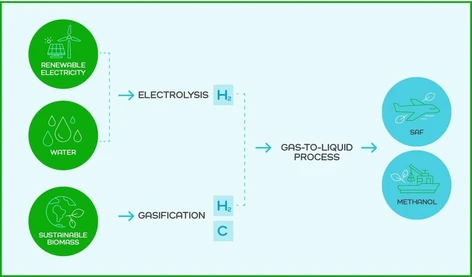
Process overview of the renewable energy megaproject. Photo by Nova Sustainable Fuels
A second environmental assessment approval will be needed for the project’s next phase, the proposed wind energy and solar farm and a transmission line that would connect more than one gigawatt of renewable energy to the processing plant. Nova Sustainable Fuels intends to submit that assessment next year.
“We’re doing the study work now to be able to file for that in 2027,” Parsons said.
A final investment decision is expected by 2028. Construction would begin later that year, and Parsons said the plant would be operational by 2031.
Share This:






















On The Verge: Energy Sector Primed for New Wave of Growth – ATB Economics