CDN NEWS |
  US NEWS







What happens when tens of thousands of construction workers suddenly find themselves out of a job?
By Geoff Russ
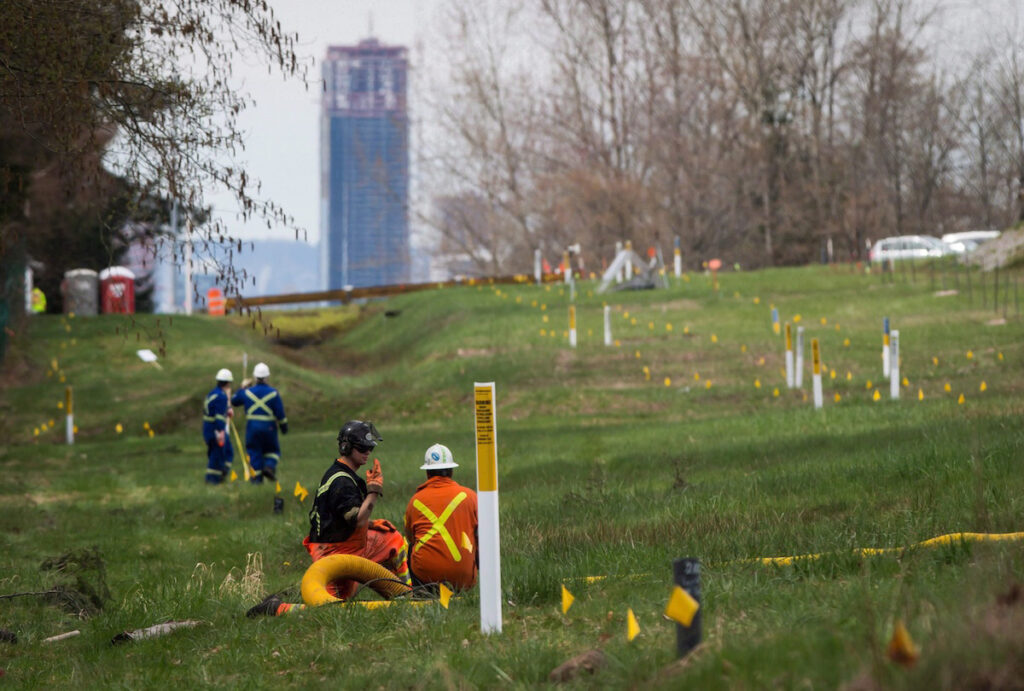
Two workers at the Kinder Morgan jobsite in Burnaby in 2018, against the backdrop of a highrise condo under construction. THE CANADIAN PRESS/Darryl Dyck
By Resource Works
More News and Views From Resource Works Here
British Columbia’s housing slowdown is spilling into the labour market, with industry warning that a prolonged decline in homebuilding could trigger a wider jobs crunch across the province.
Chris Gardner, president and CEO of the Independent Contractors and Businesses Association, warned last summer that the downturn is more than an affordability story.
“These aren’t just numbers on a page , they represent highly skilled tradespeople, well-paying jobs, and families whose livelihoods are being put at risk,” Gardner wrote, pointing to falling construction employment as projects stall.
The housing shortfall
Gardner also warned that national housing output is headed the wrong way, even as population and demand rise. “This year, Canada will build roughly 237,000 homes , 12,000 fewer than in 1972. By 2027, CMHC projects just 220,000. Two generations later, with twice the population, output is falling.”
The concern is that layoffs among residential trades could become self-reinforcing, as workers leave the sector or the province, raising costs and slowing the pace of future building just as governments push for higher housing targets.
Pipelines as an employment buffer
Proponents of major energy and export projects are pitching new construction work as a potential buffer, one that could help absorb displaced labour if housing starts remain weak.
Supporters point to the scale of the Trans Mountain expansion as a recent example of how megaproject construction can mobilise large workforces.



An Ernst and Young economic impact study cited by the Business Council of British Columbia estimated that TMX construction from 2018 to 2023 created 67,423 full-time equivalent jobs, alongside $11 billion in wages and $52.8 billion in total economic activity.
Stewart Muir, CEO of Resource Works, has been among those arguing that pipeline and midstream work can provide steadier, long-cycle employment when other construction markets soften.
“This project is a well-considered, modest expansion of an existing pipeline corridor that delivers outsized benefits for Canadians,” Muir has said.“It will enhance energy security, bolster Canada’s competitive position in natural gas, and drive economic growth, all while upholding high environmental and safety standards,” he said.
Projects on the horizon
The Westcoast Energy’s Sunrise Expansion Program in northeast B.C. is designed to increase natural gas transmission capacity on Enbridge’s T-South system by about 300 million cubic feet per day, a 17 per cent boost, adding 11 pipeline loops totalling 139 kilometres from the Chetwynd area toward the Canada U.S. border near Sumas, B.C.
At the same time, political attention has returned to the question of a new Alberta-to-coast oil pipeline, with Alberta Premier Danielle Smith publicly floating a U.S. Pacific Northwest route as leverage if a Canadian option stalls. Smith has said she wants a proposal by May 2026, with a focus on existing rights of way, including the old Northern Gateway corridor.
Last summer, Ottawa and Edmonton signed a memorandum of understanding backing a privately financed bitumen pipeline to a B.C. port, envisaging at least one million barrels a day, and mapping out an application by July 1, 2026, with governments aiming to finish approvals within two years.
A $63-billion backlog
For labour groups watching residential projects pause, a large pipeline build can require thousands of workers across earthworks, civil construction, welding, mechanical, electrical, camp services, and marine support, with spinoffs across supply chains. Supporters say that kind of work could help stabilize employment if housing continues to wobble.
Investors, meanwhile, have been signalling continued confidence in Canadian midstream infrastructure. A January 2026 BMO Capital Markets report estimated that there is $63 billion in secured growth backlogs across the Canadian pipeline and midstream sector, with the bank suggesting that could rise by as much as 20 per cent by year end.
Whether an Alberta-to-coast oil line advances remains uncertain, but it has a jobs and trade diversification file as much as an energy file, with housing and construction workers increasingly watching from the sidelines.
Geoff Russ is a writer for Resource Works, a non-partisan organization that champions responsible resource development in British Columbia and Canada. Reach Geoff at [email protected].
Share This: