CDN NEWS |
  US NEWS







By Geoff Russ
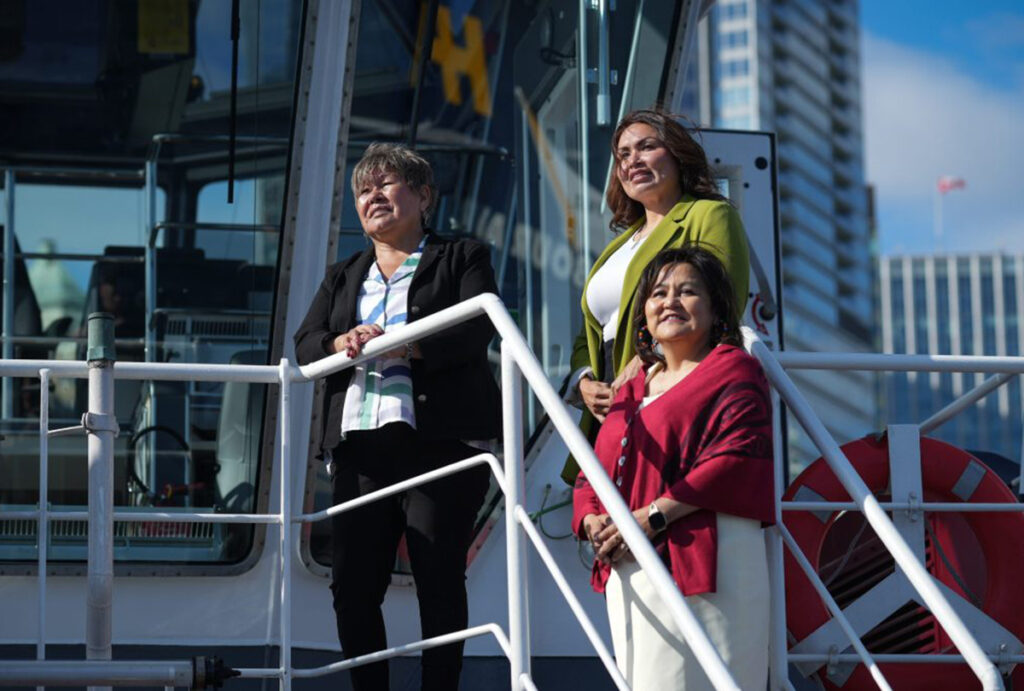
Eva Clayton, back left, President of the Nisga’a Lisims Government, Crystal Smith, back right, Haisla Nation Chief Councillor, and Karen Ogen-Toews, front right, CEO of the First Nations LNG Alliance and former chief of the Wet’suwet’en First Nation, pose for a photograph on the HaiSea Wamis zero-emission tugboat outside the LNG2023 conference, in Vancouver, B.C. THE CANADIAN PRESS/Darryl Dyck
By Resource Works
More News and Views From Resource Works Here
Pseudo-nuance begets pseudo-wisdom, which is a useful tool for masking pure insinuation.
The Walrus regrettably exemplified this with a piece published last week. It examined the climate-driven risk to the village of Kitimat, such as rising sea levels and unpredictable waves, and then tried to frame LNG development as a culprit.
Rising sea levels are a decades-long, cumulative phenomenon. While The Walrus provided an analysis, of sorts, of the natural threats to Kitimat Village, the piece is not a winning prosecution of LNG Canada, Cedar LNG, or other natural gas projects that have revitalized the local economy with the enthusiastic endorsement of the Haisla First Nation.
Indigenous decisions are not a tragic subplot
Deeply grating is the article’s attempt to turn generational Indigenous decisions into a tragic subplot.
The Haisla Nation does not exist so that an Alberta-based writer can be a character in an anti-resource morality play. In their own words, the Haisla describe such projects as key to “thoughtful, well-planned economic development” so that the nation can achieve economic self-sufficiency.
When Ottawa approved Cedar LNG, it made Haisla’s consent a pillar of the decision, along with the fact that the project supports self-governance and self-determination. Cedar LNG itself is majority-owned by the Haisla, who are not shy about announcing that they are leading “sustainable, nation-building developments”, while remaining opposed to crude oil export projects in the region.
The distinction between LNG and crude oil
LNG is not the Northern Gateway pipeline, and there are vast differences between the process of extracting and exporting the two, as well as the emissions associated with each. People should know better than to pretend otherwise or to throw all fossil fuels out with the same bathwater.



The economic case has been settled. LNG Canada, which is not owned by the Haisla but was built in partnership and cooperation with them, loaded its first LNG cargo last year. It is the largest private-sector investment in Canadian history, employing over 50,000 Canadians during Phase 1 of its construction and generating more than $5.8 billion in local contracting, including $4.9 billion for Indigenous-owned and regional businesses.
Another $500 million went toward a HaiSea Marine contract, whose fleet includes the first electric tugboats in Canada to assist LNG transport vessels and respond to emergencies.
As Cedar LNG is built up alongside LNG Canada, 500 construction jobs are being added, and 100 full-time positions will remain, which is a major boost to smaller communities like Kitamaat Village and nearby Terrace.
Dismantling the climate alarmism
On climate alarmism, the article in The Walrus falls well short. The International Energy Agency (IEA) has warned that comparing LNG to older fossil fuels like coal sets a very low bar. Ninety-nine per cent of the LNG consumed in 2024 had lower lifecycle emissions than coal, at about 25 per cent less.
The United States Department of Energy’s own lifecycle review has also concluded that LNG used for power in Asian and European markets does not increase lifecycle emissions relative to local coal.
According to the IEA, about 80 per cent of the world’s coal demand is located in Asia, with China alone burning almost 40 per cent more coal than the rest of the world combined. There is no debate that LNG is a far cleaner energy source than coal, and LNG exported from Kitimat is an effective displacement fuel for it.
A global leader in clean production
Canadian LNG is also unique. LNG Canada’s future Phase 2 is projected to supply energy with 35 per cent lower emissions than existing LNG facilities, and 60 per cent below the global average. British Columbia is home to some of the cleanest and most responsible LNG production in the world.
New rules on methane are expected to cut it by 72 per cent below 2012 levels by 2030.
Future analyses of LNG operations in British Columbia can, and should, do better.
LNG is not coal or crude oil, but a resource that is driving real innovation in adapting energy extraction to climate goals and creating Indigenous self-sufficiency. If sea levels keep rising, as they have for decades, building a seawall in Kitimat Village is hardly a challenge.
Geoff Russ is a writer for Resource Works, a non-partisan organization that champions responsible resource development in British Columbia and Canada. Reach Geoff at [email protected].
Share This: