


 CDN NEWS |
  US NEWS







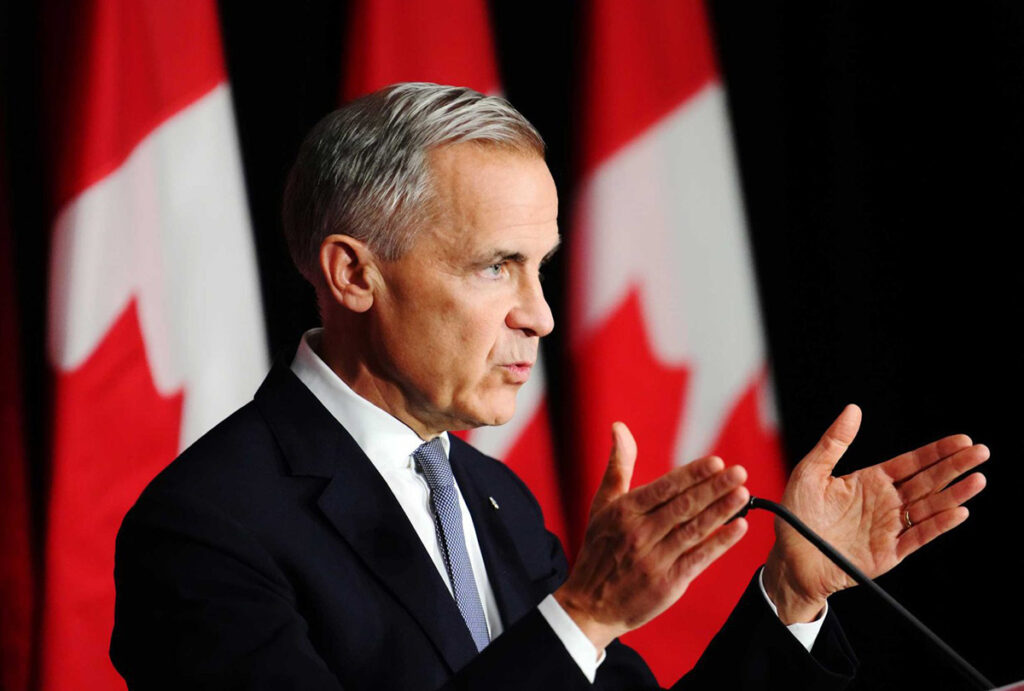
Ottawa also commits billions to charging station infrastructure and industry tax credits
Prime Minister Mark Carney says he’s delaying the timeline for the electric vehicle transition by about five years and unveiled several other auto policies Thursday, including the return of the $5,000 incentive for buying an EV.
The new automotive strategy cancelled a federal policy, colloquially known as the EV mandate, that would have required automakers to produce and sell only electric vehicles by 2035. Instead, the government plans to draft new rules by year-end that will set Canada on a path to achieve 75 per cent EV adoption by 2035 and 90 per cent by 2040 by focusing on greenhouse gas emission reductions so automakers can still produce internal combustion engine vehicles as long as their overall emissions fall.
The government also set aside $2.3 billion to bring back consumer incentives for EV purchases, $1 billion for charging infrastructure, $3 billion for industry in tax credits and other incentives and a commitment to rework the framework that rewards automakers that manufacture here.
“We are making strategic decisions and generational investments to build a strong Canadian auto sector, where Canadian workers build the cars of the future,” Carney said in a statement after announcing the strategy at an auto parts plant in Vaughan, Ont.
Industry Minister Mélanie Joly said the country’s auto industry is at a pivotal moment, beset by United States tariffs while facing a challenging EV transition.
“How do we protect what we built while positioning ourselves to lead in what comes next?” she said at a press conference. “The answer is simple: We are an auto nation.”
Beginning Feb. 16, the federal government will reintroduce a $5,000 cash incentive for EV purchases and a $2,500 incentive for plug-in hybrid purchases (PHEVs). Only autos made in countries that have free trade agreements with Canada — which excludes China — are eligible for the rebate.
The vehicles must also cost less than $50,000, although that limit is waived for EVs and PHEVs made in Canada, which includes the Dodge Charger and Pacifica minivan.
The rebates will decline to $2,000 per EV and $1,000 per PHEV by 2030, and the government said its goal is to encourage the purchase of 840,000 vehicles over a five-year time period.
It also said the Canada Infrastructure Bank would devote an additional $1 billion to developing charging infrastructure across the country.
EV mandate out
The rollback of the EV mandate had been a priority for the auto sector, which has long complained that it was too rigid and expensive.
It required at least 20 per cent of all new vehicles sold in Canada to be zero-emission vehicles (ZEVs) in 2026, 60 per cent in 2030 and up to 100 per cent by 2035. ZEVs are defined as battery-electric, plug-in-hybrid and fuel-cell vehicles.
But sales of both battery-electric and PHEVs currently account for about 10 per cent of new sales, or half of the 20 per cent threshold for 2026, according to the most recent sales data.
Under the old rules, automakers failing to meet that threshold would have had to purchase credits from EV makers such as Tesla Inc. to avoid costly penalties.
After the federal government struck a deal that allows Chinese automakers to import 49,000 EVs to Canada at a most favoured nation tariff rate of 6.1 per cent, the EV mandate was widely viewed within the auto sector as unworkable because they said it would be politically untenable to have North



“We had to scrap the EV mandate,” said Brendan Sweeney, managing director at the Trillium Network for Advanced Manufacturing, which studies the industry in Ontario.
The new system will create benchmarks for the overall greenhouse gas emissions from an automaker’s fleet and will be technology agnostic, so it will not matter what type of vehicle it produces as long as it
“During a transition period, it gives greater flexibility to industry in terms of how they meet that reduction,” Carney said.
Bringing back the EV incentive — which was cancelled in late 2024 after it ran out of money — will help Canada keep pace with the rest of the world, where EV sales are rapidly growing, he said. EV sales in Canada had exceeded 18 per cent of the total number of automobiles sold in 2024 before the incentive program was cancelled.
Credits for automakers
But Sweeney said from his perspective the big shift in policy relates to the government’s intention to rewrite its “remission” rules, which allow automakers with manufacturing operations here to import vehicles from the U.S. on a duty-free basis.
The program was drafted last year after the U.S. introduced 25 per cent tariffs on Canadian-made vehicles and was designed to encourage automakers in Canada not to move production to the U.S. But it was not entirely successful since General Motors Co. in January reduced a shift at its Oshawa plant and Stellantis NV paused the renovation of its Brampton, Ont., assembly plant last year.
Now, the federal government said it will devise a credits system so automakers will earn credits based on the number of vehicles they manufacture in Canada. The credits will allow them to import vehicles from the U.S. at reduced rates and can be sold to other automakers.
Carney said his government would look to develop a “comprehensive trade regime” to ensure that companies that produce vehicles in Canada are rewarded through a tradable credit system.
“That can be transformative,” Sweeney said. “That is what leverages our market and rewards the companies that manufacture here.”
Carney also said his team is pushing the U.S. to retain free trade conditions when the Canada-U.S.-Mexico Agreement comes up for review later this year, but is aware that the Donald Trump Administration has other objectives.
“We have to prepare for all possibilities,” he said. “We must take care of ourselves.”
The government said it will launch public consultations on how to create a remission framework that rewards automakers that use Canadian content in their vehicles.
That raises the possibility that Canada could extend its counter tariffs on autos to countries other than the U.S., said Bentley Allan, a principal at the Transition Accelerator, a Canadian economy-focused think tank, and an associate professor of political science at Johns Hopkins University.
“The prime minister’s outline of a comprehensive trade framework raises the question of whether counter tariffs would be extended beyond the U.S.,” he said.
To that end, Carney said “accelerated investment” in the auto sector, including parts companies and possibly extending to steel and aluminum companies, should be the first pillar of the strategy.
The government said it has set aside $3 billion from the Strategic Response Fund and $100 million from the Regional Tariff Response Initiative to support those investments, although it did not say exactly how it will use those funds.
Share This:




















SETTING OFF ALARM BELLS: Carney’s EU Deal Threatens Alberta, Energy, & Sovereignty – 170,000 Reasons to Reject Canada’s EU “Associate Membership” – The Nemeth Report