CDN NEWS |
  US NEWS









By Yogi Schulz
Multiple opportunities exist for the Canadian oil and natural gas industry to further reduce methane emissions at a reasonable cost.
The oil and natural gas industry has made commendable progress in reducing methane emissions, as shown on the chart below. Nonetheless, the industry can contribute to addressing climate change by reducing greenhouse gas (GHG) emissions.
Alberta’s oil and gas methane emissions
The chart shows that Alberta’s oil and gas methane emissions are estimated to have been reduced by about 52% between 2014 and 2023. The reduction in methane emissions is particularly impressive, given that Alberta’s oil and gas production roughly doubled over the same period.
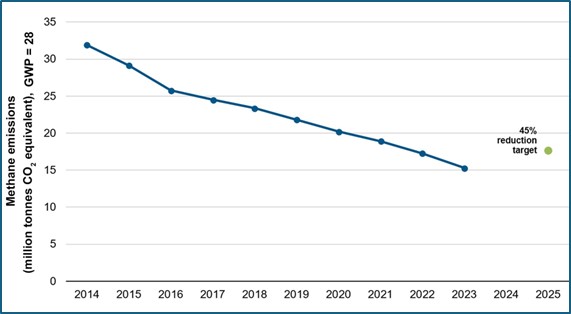
Source: Methane Performance, AER, November 2024
This excellent performance stems from years of technological innovations that reduce the energy consumed to produce each barrel of oil, along with many improvements in leak detection.
Some would say that’s good enough and claim that pushing for further reductions will only:
- Increase operating costs for immaterial decreases in methane emissions.
- Reduce the competitiveness of the Canadian oil and natural gas industry.
- Reduce investment in the Canadian oil and natural gas industry, which has brought prosperity to many Canadians and substantial tax revenue to fund social services.
That’s a pessimistic assessment. Canadian producers can continue their improvements at a modest cost.
Canadian emissions compared to those of other countries
The chart below confirms that Canadian producers have superior GHG emissions performance compared to producers in other countries.
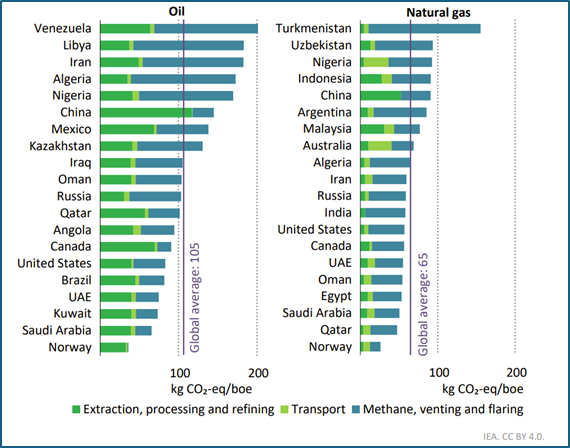
Source: Expanding Canadian energy production could help lower global emissions, Fraser Institute, November 21, 2025
The chart also shows the remaining opportunity to further reduce GHG emissions, as some major producing countries are performing better than Canada.
The Ottawa-Alberta MoU extended the target date for achieving a 75% reduction in Alberta’s oil and gas methane emissions from 2030 to 2035. However, many environmentally conscious Canadians expect continued progress from the oil and natural gas industry. It’s not clear whether the industry can meet the 2035 target.
Methane emissions are significant
Notwithstanding this commendable progress, the available data suggests that the oil and natural gas industry still produces significant methane emissions.
The Canadian oil and natural gas industry accounts for over one-third of Canadian methane emissions, or about 35 MtCO2e annually.
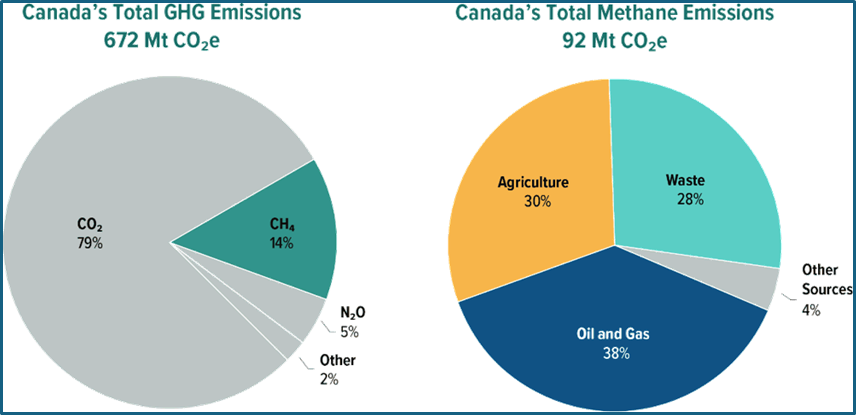
Source: Canada releases Faster and Further: Canada’s Methane Strategy, September 2022
Unfortunately, the remaining methane-emission reduction opportunities are small and geographically dispersed across tens of thousands of wells and facilities in the three western provinces, especially in Alberta.

Here are the ideas that every oil and natural gas producer can consider to continue reducing methane emissions. This article focuses on methane emissions rather than broader GHG emissions because the number of methane-emission points is much lower and the recommended actions are clearer.
Replace venting with flaring
Whenever a flared volume replaces a methane venting volume, the associated GHG reduction is 95%.
There are many producing locations in Alberta where producers can install small flare stacks or thermal combustors. These areas are shown on the map below.
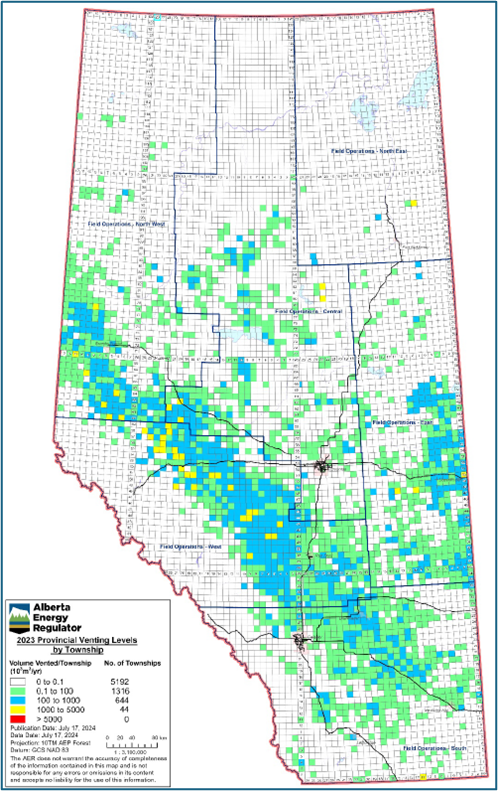
Source: Upstream Petroleum Industry Emissions Report Industry Performance for Year Ending December 31, 2023, 2024 AER ST60B, January 2025, page 30.
In 2023, venting reported in Petrinex totalled 303.5 106 m3. Although this volume has decreased steadily since 2014, many dense-producing areas exist in Alberta, where vented volumes can be gathered and flared at a modest cost. Reducing the minimum volume and price of flare stacks and combustors is a related opportunity that remains to be explored.
Replace venting and flaring with consumption
Whenever a vented or a flared methane volume is consumed instead, the associated GHG reduction is 100%.
The opportunities for consumption include:
- Turning methane into usable electricity for consumption at the producing facility or other applications, such as bitcoin mining.
- In Alberta, vast rural gas networks, operated by 81 natural gas co-operatives, are excellent potential consumers as an alternative to venting or flaring. The map of the service areas below shows many overlaps with the venting map above.
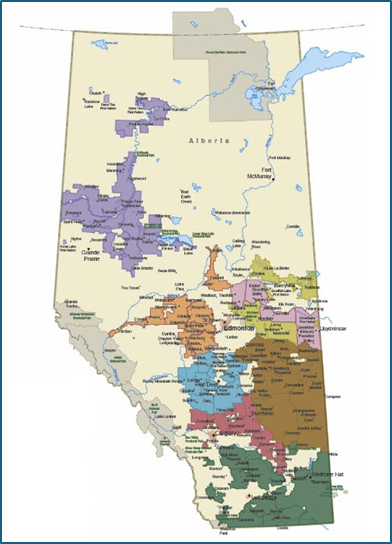
Source: Alberta natural gas co-operatives map
In 2023, flaring volumes increased to 1370.3 106 m3. This volume has increased steadily since 2016, creating many locations in Alberta where these volumes can be gathered and consumed by natural gas co-operatives or other consumers at a modest cost.
Reduce fugitive emissions
Whenever a producer avoids a fugitive methane volume from production equipment, the associated GHG reduction is 100%. There are tens of thousands of pieces of production equipment in Alberta where these fugitive volumes can be avoided.
The chart below shows that producers have reduced their fugitive emissions from 2020 to 2023.
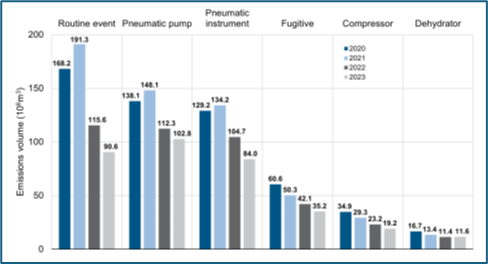
Source: Upstream Petroleum Industry Emissions Report Industry Performance for Year Ending December 31, 2023, 2024 AER ST60B, January 2025, figure 9, page 14.
In 2023, fugitive emissions reported in OneStop totalled 343.4 106 m3. This volume is a significant decrease from 415.3 106 m3 reported in 2022. The oil and natural gas industry has additional opportunities to reduce its fugitive emissions from routine flaring and pneumatic equipment.
The oil and natural gas industry has made excellent progress in reducing methane emissions from 2014 to 2023. A similar effort will be required to achieve an overall 75% reduction by 2035.
Yogi Schulz has over 40 years of experience in information technology in various industries. He writes for Engineering.com, EnergyNow.ca, EnergyNow.com and other trade publications. Yogi works extensively in the petroleum industry to select and implement financial, production revenue accounting, land & contracts, and geotechnical systems. He manages projects that arise from changes in business requirements, the need to leverage technology opportunities, and mergers. His specialties include IT strategy, web strategy, and systems project management.
Share This: