


 CDN NEWS |
  US NEWS







A regulator tried to decide the energy transition by inference. The government pushed back. Everyone else was left guessing.
By Stewart Muir
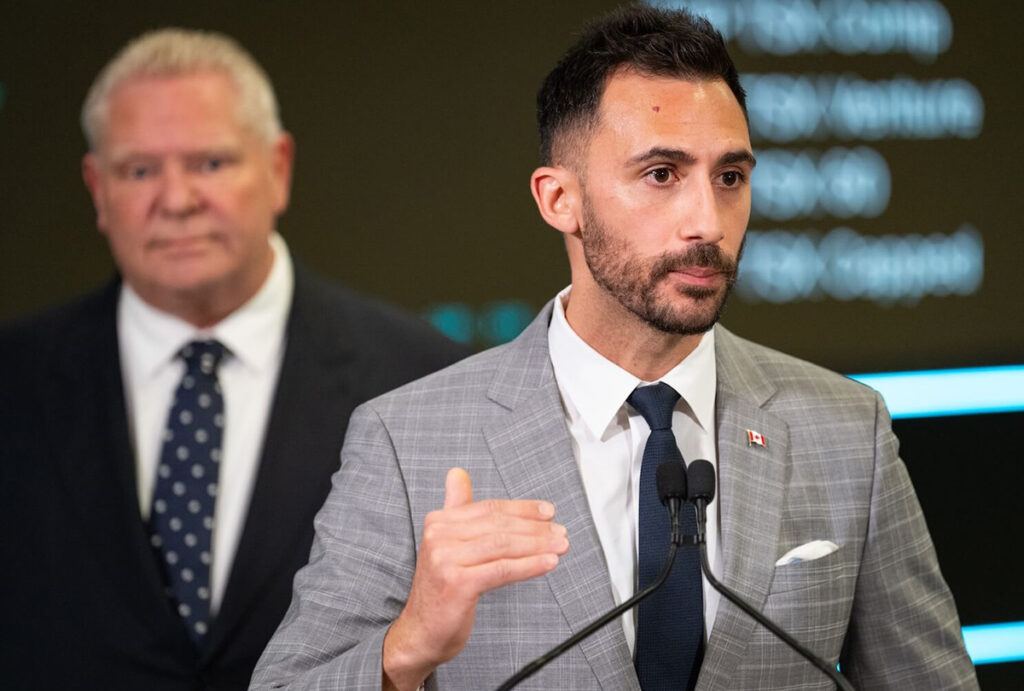
Ontario Energy Minister Stephen Lecce speaks as Premier Doug Ford looks on in Toronto. THE CANADIAN PRESS/Arlyn McAdorey
By Resource Works
More News and Views From Resource Works Here
Ontario is not just another province with a policy paper or an aspirational launch event. It is Canada’s most populous province, home to roughly 40 per cent of the country’s population and far and away the largest single energy market. What happens here matters everywhere else — because the challenges Ontario is confronting are the ones every jurisdiction chasing electrification sooner or later will run into.
But here’s the kicker: Ontario already has an energy system under strain — and a recent regulatory ruling made that strain worse by trying to solve a political question with a technical fix.
Let’s unpack it.
The decision that sparked the fight
In Dec 2023, the Ontario Energy Board (OEB) made a decision that has become the flashpoint for this tug-of-war. The board ruled that Enbridge Gas could no longer amortize the cost of connecting new customers to the natural gas system over a long period. Instead of the long-standing 40-year revenue horizon — meaning new developments could recover pipe connection costs over decades — the OEB set that horizon to zero years, requiring developers or new home buyers to pay their full cost upfront. That effectively makes natural gas connections far more expensive at the point of sale.
Critically, the OEB justified this on the basis that future energy transitions — especially electrification — could render gas infrastructure financially risky or stranded. In doing so, it strayed from simply evaluating cost recovery into choosing winners and losers in the energy mix without a legislated mandate to do so.
This is where the referee tried to call the playbook.
The government pushes back
Clearly unhappy, the Ontario government lost no time in signalling that it would reverse that direction because of what it saw as a threat to housing affordability and economic growth. As Ontario lawmakers explained in the legislature, the OEB’s zero-year horizon would have added “thousands of dollars” to the cost of new homes by making developers bear expensive gas hookup costs up front rather than amortizing them over decades — something the government argued should stay at 40 years.
That reversal was not just technical. It was political and sweeping: instead of a regulator deciding what future energy pathways should look like, the province made it explicitly clear that elected officials do that. In June 2025, the government released Energy for Generations, its first integrated energy plan, and passed legislation reinforcing that government — not the regulator — sets broad energy policy direction.
The reality check: Grid constraints
This matters because Ontario’s energy system is under real pressure.



Even if electricity demand in Ontario grows exactly as forecast — roughly 75 per cent by 2050, driven by electrification, population growth, electric vehicles, heat pumps, data centres and industrial expansion — the province does not have a credible domestic supply plan to meet it.
The Independent Electricity System Operator has been clear that without natural gas generation and gas-backed heating remaining in the system, Ontario faces real capacity shortfalls well before mid-century.
Wind and solar are growing, but they do not reliably deliver power on cold winter evenings — precisely when Ontario’s demand peaks and the system is under maximum stress.
And while nuclear refurbishments will keep existing reactors running, new nuclear projects remain largely conceptual, and hydroelectric potential is essentially tapped out. With the supply outlook stretched tight, this raises a stark question: in the middle of a looming gap, why would any energy regulator in its right mind make it nearly impossible to supply more gas — the very fuel that keeps the lights on when the wind isn’t blowing and the sun isn’t shining?
Ambition without clarity creates a vacuum
That question landed with force inside Queen’s Park.
Ontario’s Minister of Energy and Mines, Stephen Lecce, has repeatedly framed the government’s approach as pragmatic because the province needs “affordable, reliable and clean energy” to power growth, homes and businesses and to meet record demand, with policy guided not by guesses but by an integrated plan that accounts for all fuels. Ontario Energy Board
In plain terms: the referee had tried to call the game plan, and the coach took the clipboard back.
This wasn’t about a rogue regulator. It was about policy negligence — governments dancing around hard trade-offs in broad, aspirational language without specifying binding timelines, trade-offs, system limits or credible supply roadmaps. They talk about electrification without confronting grid constraints. They talk about emissions without explaining costs. They talk about “role of natural gas” without defining how long it stays or on what terms.
When that happens, regulators inevitably fill the gaps.
Ontario has seen this movie before — under McGuinty and Wynne, when coal was shut down without a clear replacement strategy, long-term power contracts were signed at inflated prices, and costs were deferred into the future through accounting tricks that hid their impact. Those choices left Ontario with some of the highest electricity costs in North America and a public that had simply stopped trusting energy planning. Now, that history is repeating in a different form. And other provinces watching — British Columbia, Alberta, and jurisdictions south of the border — should take note: ambition without clarity creates vacuum, and vacuums get filled by inference, not evidence.
The energy transition is an enormous undertaking, involving an economy-wide transformation of energy consumption, transportation, and production. Some critics have been pointing out that what’s needed now is “a thoughtful and rigorous reimagining, if not reinvention, of public utility regulation.”
Energy systems don’t run on slogans. They run on physics, economics and trust. Ignore any one of those, and the lights eventually flicker — or go out.
Share This:





















