CDN NEWS |
  US NEWS







‘The economic and geopolitical threats that our country is facing are very serious. And blind opposition to nation-building, reindustrialization and defence spending will put our country in a precarious state’
This Article & More From Chris Varcoe Here
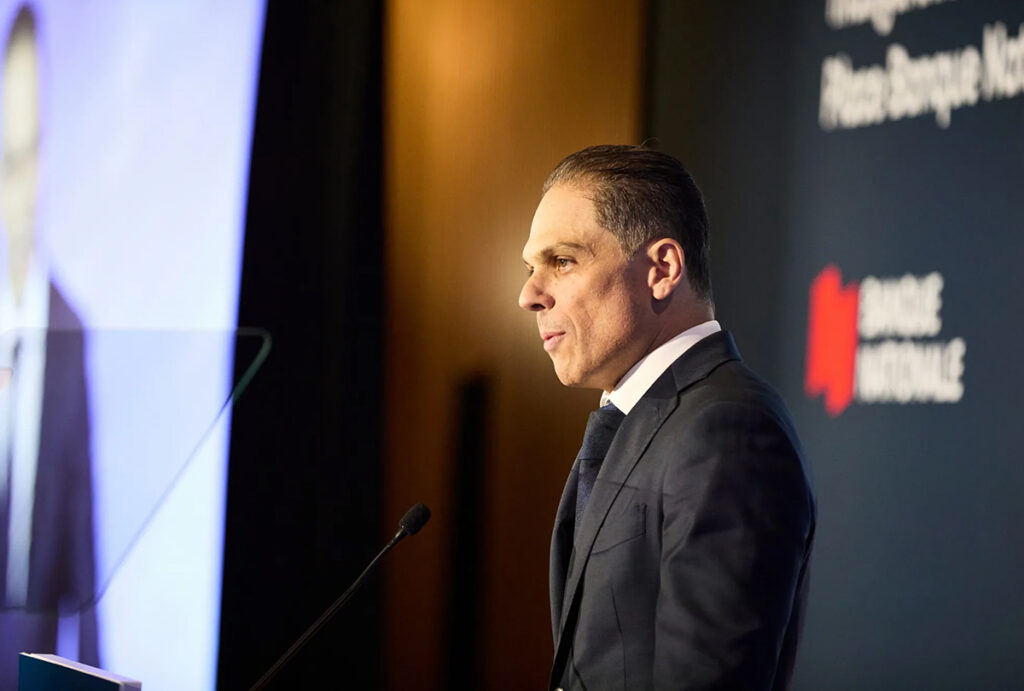
The energy pact between Alberta and the federal government is a positive first step — and becoming an energy superpower is “a necessary condition” to protect the country’s economic sovereignty, says the head of the National Bank of Canada.
Amid trade tensions with the United States, excessive regulatory burdens and geopolitical uncertainty are key issues facing the country’s economy today, National Bank CEO Laurent Ferreira said Wednesday in Calgary.
“We are in an era of peak geo-economic conflicts. And Canada is in the thick of it, with growing geopolitical threats at our doorstep,” Ferreira told about 600 people at a Calgary Chamber of Commerce luncheon.
“The economic and geopolitical threats that our country is facing are very serious. And blind opposition to nation-building, reindustrialization and defence spending will put our country in a precarious state,” he added.
“Becoming an energy superpower is a necessary condition to protect our economic sovereignty. Alberta has been right all along, and Ottawa is now on board . . . The MOU with Alberta is encouraging.”
Ferreira’s speech to the local business audience occurred on the same day that Prime Minister Mark Carney sat down with Premier Danielle Smith and her B.C. counterpart, David Eby, in Ottawa. The high-profile energy memorandum of understanding (MOU) was discussed during the session.
It also comes after rising tensions between Carney and U.S. President Donald Trump, while the fate of the review of the existing Canada-United States-Mexico Agreement (CUSMA) this summer remains unclear.
In recent months, the federal government has taken steps to secure new international trade deals, and identify major infrastructure projects that can expand the country’s exports.
The energy agreement signed between Ottawa and Alberta last November is another piece of the puzzle.
It will see the province advance its proposal for a new bitumen pipeline to the B.C. coast — an idea that Eby has opposed — and a multibillion-dollar carbon capture and storage network in the oilsands.
Trade tensions with the U.S. are affecting each province in different ways, slowing business investment, softening labour markets and leading to slower economic growth, Ferreira said.
However, the federal government has an economic agenda, and the country has ample natural resources and a strong financial system, he noted.
“Our risks as a country . . . are complacency and delays caused by bureaucratic red tape,” said Ferriera, whose company completed a $5-billion acquisition of Edmonton-based Canadian Western Bank last year.
“We have a very solid banking system, we’re there. The problem is permitting. It’s getting projects to take off.”
The bank expects the Alberta economy will expand by 1.9 per cent this year, eclipsing national growth projections. Population growth in the province, while slowing, will still hit 1.2 per cent this year, while it’s stagnant nationally.



On Wednesday, the Bank of Canada’s new monetary policy report forecast the country’s GDP is projected to rise by 1.1 per cent — after likely stalling during the fourth quarter — and by 1.5 per cent in 2027.
It pointed out that Canadian exports have dropped about four per cent below where they were before American tariffs and trade restrictions were introduced last year.
“The Canadian economy is adjusting to the structural headwinds of U.S. protectionism. Businesses are reconfiguring supply chains and investing in new markets,” Bank of Canada governor Tiff Macklem said Wednesday, as the central bank kept its key policy rate at 2.25 per cent.
“But it will all take some time.”
Building new infrastructure, including projects that can increase exports abroad, are longer-term investments. It’s expected a new oil pipeline to B.C. could be operating in the early 2030s, if it’s approved and Alberta finds a private-sector backer.
“I wish we would be moving much faster. I think it’s a definite shift. We have to appreciate the fact that there has been a change in tone,” Ferriera said in an interview.
The MOU “is a very positive first step. I think there’s a lot more that needs to be done and what all of these requirements mean. The good thing is we have alignment now in our country to move forward on the pipeline.”
In Ottawa, Smith told reporters that Wednesday’s meeting was productive.
It involved discussions about the energy MOU, including the pipeline, LNG, optimizing the capacity of the existing Trans Mountain pipeline to the Pacific Ocean and building electricity interties.
“We’ve got some work to do, of course, consulting with First Nations, but we’ve pledged to keep (Eby) in the loop as those conversations go on,” Smith said.
“We’re going to have our project (submitted to the federal Major Projects Office) in June, and so there’ll be a little bit more clarity about what the route is. And I think that will go a long way toward getting support from First Nations.”
Calgary Chamber of Commerce CEO Deborah Yedlin emphasized that it’s important to keep moving forward on major projects and the Alberta-Ottawa energy agreement.
“The way things have changed in the past four months, especially since (November’s federal) budget was tabled, the time frame has shortened up significantly,” Yedlin said.
“We have to move in double-time.”
Chris Varcoe is a Calgary Herald columnist.
[email protected]
Share This: