


 CDN NEWS |
  US NEWS







Ottawa and Alberta have cleared a path to the West Coast. If producers want this pipeline, they need to stop stalling, meet their carbon capture commitments, and keep things simple.
By Geoff Russ
By Resource Works
More News and Views From Resource Works Here
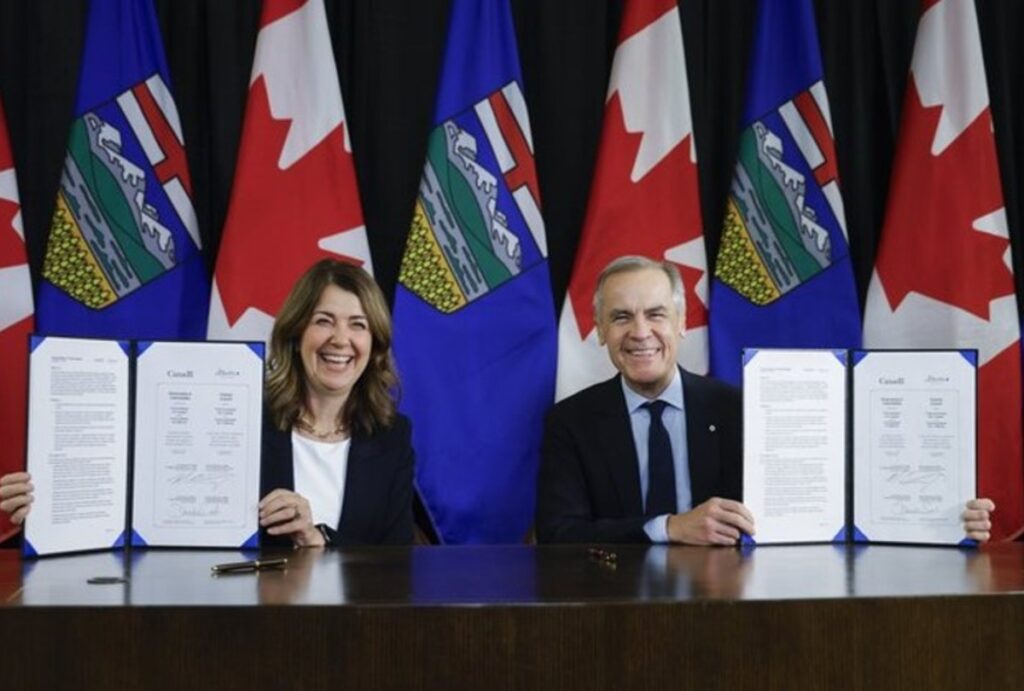
Last month, Ottawa and Edmonton finally did their part. With Prime Minister Mark Carney and Premier Danielle Smith signing a landmark MOU that ties a new West Coast pipeline to the Pathways carbon capture network, the remaining uncertainty now sits with private industry.
The agreement is intentionally blunt. The bitumen pipeline to a deep-water British Columbia port, designed to move about one million barrels a day to Asian markets, will proceed only if the Pathways Plus carbon capture and storage system is built. The federal government calls Pathways the world’s largest CCUS project, expected to add $16 billion to GDP while cutting emissions at more than 20 oilsands facilities linked by a 400-kilometre CO₂ trunk line.
This bargain did not appear out of thin air. The International Energy Agency now projects that, under current policies, global oil and LNG demand will keep rising for decades even as the world misses its 1.5 C climate target. At the same time, Deloitte’s latest outlook shows companies holding tight to capital, with only a minority expected to grow revenues by more than five per cent as they weigh costs and policy risk.


A decade of hesitation meets a political breakthrough
That caution is already visible in Canada. In recent years, the Pathways Alliance has edged towards a final investment decision while Ottawa and Alberta sweetened the pot with a 50 per cent federal investment tax credit and a 12 per cent provincial grant, as detailed in both government statements and Calgary business coverage on the project’s “fish or cut bait” year. Federal Natural Resources Minister Jonathan Wilkinson has warned it is time to move, and former oilsands executive Martha Hall Findlay has called Pathways “by far the largest emissions-reduction success story in Canadian history” that is “at risk.”
The new MOU tries to end the delay. Ottawa has shelved its oil and gas emissions cap and suspended Clean Electricity Regulations in Alberta, promised a streamlined review process, and even signalled flexibility on the northern B.C. tanker moratorium. In return, Alberta will raise its TIER industrial carbon price to $130 per tonne, extend its CCUS incentive, build big interties to B.C. and Saskatchewan, and champion Indigenous co-ownership in both the pipeline and Pathways.
A high price — but a decisive moment
Critics are right that this comes at a steep price. The Fraser Institute notes that Alberta is signing on to an ambitious net-zero 2050 agenda while accepting higher carbon costs and an expensive technology whose track record at scale remains uncertain. Those are not trivial risks in a world where upstream oil and gas investment has already fallen sharply from its 2014 peak and, according to Rystad analysis cited by Reuters, looks “flattish” for years to come.
Yet the larger point is that the political work is now essentially done. After a decade of regulatory paralysis, Ottawa and Alberta have agreed to clear timelines, defined carbon pricing and a shared narrative: Canada will sell low-emission barrels to allies while cutting the emissions intensity of oilsands production, as both legal and policy analyses of the Memorandum of Understanding underline. If this package cannot get a pipeline and CCUS network built, it is hard to imagine what will.
That is why the biggest variable now is private industry. For years, global majors and Canadian producers have told investors they believe oil and gas will be needed for decades, yet have behaved cautiously, preferring buybacks and dividends to long-dated projects amid policy uncertainty, a pattern flagged by Reuters. If the Pathways partners now inflate the complexity of their own commitments, chase gold-plated designs or insist on still richer subsidies, they risk collapsing the bargain they spent years lobbying to achieve.
The smarter strategy is simpler. Meet the obligations clearly on the table, design the first phase of Pathways to be robust but not extravagant, and lock in the regulatory certainty and market access that this deal offers, as legal observers at McCarthy Tétrault have noted. Perfectionism is the enemy here. In a world of tight LNG markets and rising data-centre demand, doing the minimum required to honour this deal would be more than enough to finally get another West Coast pipeline built.
Share This:






















INSIGHT: Canada’s Natural Resource Sector is at the Heart of the Government’s ‘Export & Diversification’ Plan