CDN NEWS |
  US NEWS







David Keane reflects on policy, innovation, and the opportunity Canada cannot afford to miss.
By Stewart Muir
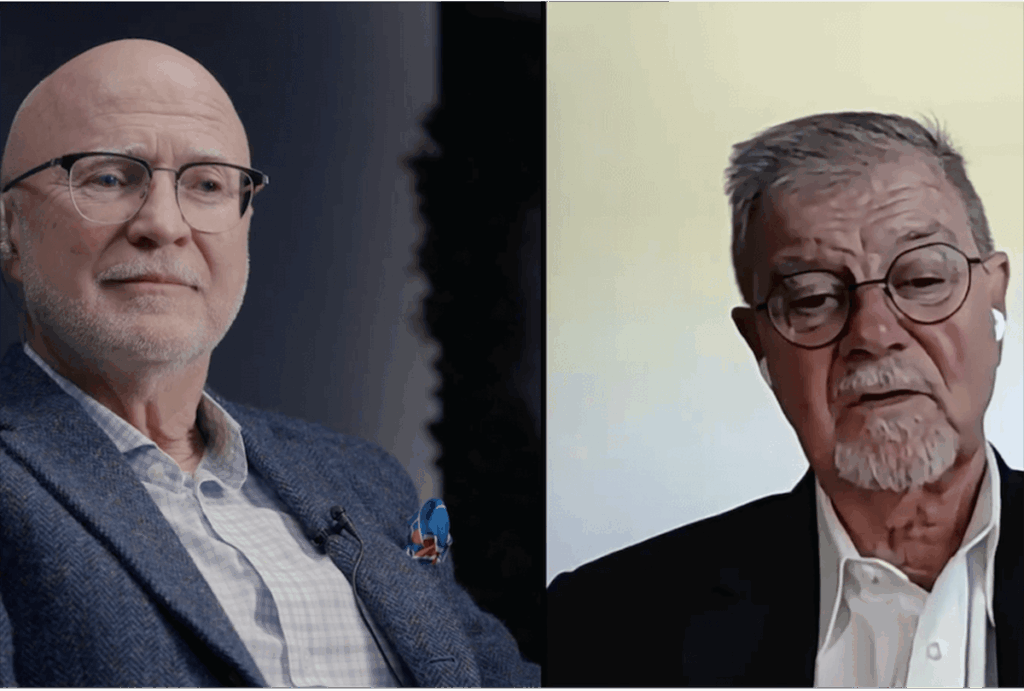
Stewart Muir (left) and David Keane
By Resource Works
More News and Views From Resource Works Here
Every industry has its builders — the people who help shape its character long before it becomes part of the national conversation. In Canadian LNG, that figure is David Keane. It’s why I once introduced him as “the Godfather of the Canadian LNG industry.” Keane’s career spans the early rush of more than twenty West Coast LNG proposals to the cautious optimism we see today, as global demand continues to rise.
When Keane joined me on Power Struggle, the remarkable thing was not just the numbers he talked about — though they still astonish — but the clarity with which he situated Canada’s LNG story within a world in flux. As he put it, “Demand for natural gas is growing… and it’s going to go well beyond 2050.” It was not said as a boast, but as a sober reminder that energy systems rarely follow the tidy timelines we wish they would.
That perspective matters, because for Keane, the heart of the LNG opportunity isn’t merely economic. It’s about where global supply will come from. Either countries like Canada — working to reduce emissions — will meet that need, he told me, or it will be “Russia, Iran, the Middle East… places where they don’t really care about greenhouse gas emissions.” In an age of geopolitical uncertainty, the implications are hard to ignore.
Innovation, policy, and a missed opportunity
Keane arrived in Canada in 2011 and immediately saw how policy could shape — or hinder — national opportunity. He spoke candidly about a period when Canada struggled to match the competitiveness of its American counterparts. His reflections on the shelved East Coast projects were especially striking. “Think about where Canada would be,” he said, if facilities like Goldboro had transitioned from import to export and were today supplying LNG to Europe. It was a quiet but pointed reminder of the cost of hesitation.
Yet Keane is not one to dwell on setbacks. He is far more interested in what can be built — and how.
Woodfibre LNG and the new shape of Canadian projects
I was particularly struck by the reasons that drew him, after decades in the industry, to lead Woodfibre LNG in 2018. Two stood out. First was the groundbreaking regulatory role of the Squamish Nation, which Keane described as unprecedented for a major project in Canada. The second was the design: an all-electric facility using renewable electricity from BC Hydro.



In his view, that combination represented something uniquely Canadian — a way of producing LNG with among the lowest emissions anywhere in the world. It is, in many ways, the model for where the industry needs to go: technologically advanced, collaboratively governed, and globally competitive.
The gap between perception and reality
Keane has always pushed back against the stereotypes that surround natural gas development. He knows the difference between the Hollywood version of hydraulic fracturing and the technical reality. “These are highly trained technicians,” he reminded me, people who use precision tools capable of drilling horizontally for miles with exact control of subsurface conditions. It’s the kind of innovation that rarely makes headlines, yet defines the sector.
Hearing him describe it, I was reminded that one of Canada’s ongoing challenges isn’t the lack of technological progress — it’s the lack of public understanding of that progress. Too often, the narrative lags behind reality.
A longer view: Trust, time, and relationships
What Keane returned to again and again was the importance of listening. Whether with communities or First Nations, he believes long-term success depends on early, honest engagement.
His guiding principle is deceptively simple: respect the timescale of those you are working with. Indigenous Nations think in terms of millennia; companies often think in decades. Bridging that gap requires humility, not just consultation.
It is a lesson that resonates across every energy debate in this country.
Speaking with Keane reminded me why I value conversations like this. They move beyond slogans and into the deeper realities of how Canada can — and should — participate in global energy systems. He does not claim LNG is a cure-all, nor do I. But he sees clearly that Canada’s choices today will echo for generations—in jobs, in climate outcomes and in geopolitical alignment.
In that clarity, there is something profoundly Canadian: pragmatic, principled and quietly ambitious.
Watch the video on Power Struggle
- Power Struggle audio and transcript
- David Keane on LinkedIn
- Stewart Muir on X
- Stewart Muir on LinkedIn
Power Struggle on social media:
- Power Struggle on LinkedIn
- Power Struggle on Instagram
- Power Struggle on Facebook
- Power Struggle on X
Share This: