CDN NEWS |
  US NEWS








By Jim Warren
There she goes again. For the second time in three weeks Elizabeth May has tried to mislead Canadians. Most recently May incorrectly claimed oil tankers operating from Prince Rupert would be sailing through Canada’s most dangerous waters and the fourth most dangerous waters in the world.
The previous instance of deception was May’s false claim that Canada was legally bound by an international treaty to meet its green transition and net zero commitments. She told that whopper on November 17, the day the House of Commons narrowly approved the Liberal budget.
Since misconstruing the treaty, May has drawn media attention to a video she released which claims tankers leaving the proposed Northern Gateway 2.0 terminal will travel through the allegedly perilous Hecate Strait which separates the Haida Gwaii islands (formerly the Queen Charlotte Islands) from the West coast of the B.C.
Somebody better tell the B.C. Ferry Service their regularly scheduled runs across the Hecate Strait from Prince Rupert to Haida Gwaii are putting lives at risk.
Online fact checkers have determined the hyperbole regarding the safety of the strait traces back to 1992 and an extraneous comment in the Marine Weather Hazards Manual, West Coast Edition : A Guide to Local Forecasts and Conditions.
The manual indicates high winds can develop quickly over the strait making sailing hazardous for smaller vessels. This is followed by an unsubstantiated comment about it being the most dangerous waterway in Canada. Students of late 20th century history assume the comment is an embellishment based on an anecdote that was improperly inserted by whoever wrote the manual. It is not any sort of official ranking.
Oil tankers are obviously nothing like the small vessels that can encounter problems in the strait. And besides that, loaded tankers leaving Prince Rupert can avoid the Hecate Strait altogether by way of the Dixon Entrance which connects Prince Rupert to the wide open Pacific.
The map shown below was produced by The Hub, one of the fact-checking websites which has challenged May’s false claims about the hazards facing oil tankers at the Northern end of B.C.’s West coast.
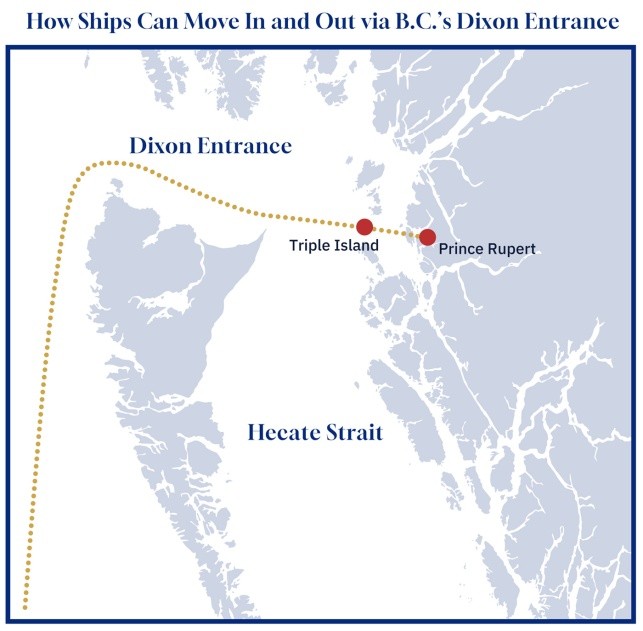
Source: Falice Chin (2025, November 25).
https://thehub.ca/2025/11/25/fact-check-elizabeth-mays-tanker-ban-claims-dont-add-up/
May’s outright misrepresentations of the Paris Climate Agreement and the safety of shipping out of Prince Rupert reflect the environmental movement’s all too frequent exaggerations about the dangers posed by climate change and conventional energy.
The argument which follows shows how the Prince Rupert oil pipeline terminal can play a role in the effort to increase global oil tanker safety and reduce the danger of oil spills
If it weren’t for the dark (aka shadow) tanker fleets transporting Russian and Iranian oil, the environmentally alarmed could rest a lot easier about oil tanker safety. Over the past several decades there have been tremendous improvements in oil tanker design and safety technology.
The last major oil tanker spill on the West coast of North America was the 1989 Exxon Valdez oil spill, which resulted in 240,000 barrels of crude being dumped into Alaska’s Prince William Sound.


The Exxon Valdez disaster prompted the US Congress to pass the Oil Pollution Act of 1990. The Act required the gradual phasing in of double hulled construction for new oil tankers. The US Coast Guard claims that if the Exxon Valdez had been a double hulled vessel it would have cut the amount of oil spilled by 60%.
The US double hull requirement has since become the global standard for the design of new, large oil tankers. That being said, there are a number of countries and shipping companies that operate outside the confines of international best practices. These are the countries and companies which facilitate the operation of the world’s dark fleets.
In response to Russian’s invasion of Ukraine in February 2022, the EU, NATO members and several other G20 countries imposed a set of trade and financial sanctions on Russia. The 2022 package was much tougher than sanctions imposed on Russia after its 2014 occupation of the Donbas and seizure of the Crimea.
The new sanctions imposed in 2022 included restrictions on Russia’s ability to export oil into international markets. While some of the sanctions soon proved to be rather toothless, efforts to prevent the world’s major shipping insurers like Lloyd’s of London from insuring ships carrying Russian oil were more successful. Owners of the world’s modern tanker fleets refused to transport Russian crude. It was simply too risky. A tanker accident and oil spill, especially along a coast line or near a major coastal urban centre can be monumentally expensive. Companies operating uninsured or poorly insured tankers would also find it difficult to obtain bank financing and new investors.
It was assumed that the oil sanctions would damage the Russian economy and seriously handicap its ability to wage war against Ukraine. After all, as US Senator John McCain famously said, “Russia is a gas station masquerading as a country.” Oil and natural gas have kept the Russian economy afloat since the collapse of the Soviet Union.
Russia’s friend, Iran, has been dodging oil sanctions for decades and happily shared that know how with its pals at the Kremlin. For starters, Russia’s oil exporters needed to gain access to tankers owned by operators who didn’t worry about insurance or if they were insured it was by shady companies operating out of countries that weren’t too worried about things like oil spills.
In relatively short order, Russian oil interests acquired a fleet of dark tankers which could be operated outside the bounds of properly insured shipping. Over the course of 2022 and 2023, the market price for old, used oil tankers which had outlived their best before dates but could still float more than doubled. Many of the derelict rust buckets lacked modern double hull construction.
The size of the world’s sanctions dodging dark fleets doubled after February 2022. Today it is estimated to be somewhere between 1,000 to 1,400 ships. Most of the ships are oil tankers but some are container vessels.
Since the vast majority of the older ships in the dark fleet are small to mid-size tankers it makes sense to transfer the Russian oil into larger tankers, on the open ocean, far from prying eyes. This reduces overall shipping costs and facilitates laundering of the oil. Once it is in the larger tanker Russian oil looks like anybody else’s oil. While transferring oil from ship to ship can and is done very safely, it becomes less safe when one of the ships is a floating pile of scrap iron.
In 2023, The Economist reported that Malaysia and the UAE were suddenly selling more than twice as much oil as they are capable of producing in a year. It’s alleged they are operating as middleman states which facilitate the laundering of Russian oil. The Economist claimed that Russian oil revenues fell in 2023. However, they returned close to pre-sanctions levels by the end of 2024. In other words, the sanctions have been a flop.
Despite the practice of transferring oil to larger ships, most Russian oil is transported all the way from Russia to final customers on smaller shadow fleet ships. Many of the ships in the dark fleet are chronic leakers and vulnerable to larger spill events. Luckily for the Russians, there are ports in China and several developing countries like India, and Malaysia willing to accept shadow fleet shipments. Some port operators are prepared to accept tankers insured by sketchy or fake insurers. Port authorities in these countries are willing to look the other way when antique tankers hemorrhage oil into their harbours. Not all spills and leaks are reported, so the full extent of the environmental harm is unknown.
It’s only a matter of time before one or more of the floating sieves in the dark tanker fleet causes a major oil spill in international waters that captures the world’s attention. Denmark has recently taken action against defective dark fleet tankers transporting Russian oil from the Baltic to the Atlantic. The ships have to pass through narrow straits controlled by Denmark where there is a somewhat higher risk of accidents. Last month, the Royal Danish Navy began randomly stopping and inspecting tankers carrying Russian oil.
The takeaway worth noting here is that should Northern Gateway 2.0 be approved and actually built, every barrel of oil shipped from the Prince Rupert terminal will be a barrel that Russia cannot sell via its shadow fleet. It will be a barrel of oil transported by double hulled, state of the art tankers. Furthermore every barrel of oil shipped from Prince Rupert will be a barrel of oil that will not subsidize Russia’s war of aggression against Ukraine.
Elizabeth May, you are wrong again. The oil pipeline from Alberta to Prince Rupert stands to contribute to greater global tanker safety in part because it can contribute to a loss of Russia’s market share in the Asia Pacific region. Shipments from Canada crossing the Pacific using large, modern tankers will cost far less than the cost of shipping over longer distances using smaller (less safe and efficient) ships to transport oil from Russia to that part of the world. Canadian producers should have the ability to sell their oil profitably at a lower price than Russian competitors need to obtain due to their much higher transportation costs.
Of course, profitability for Canadian exporters will depend on how high any carbon or other environmental taxes Ottawa imposes might be.
Share This: