


 CDN NEWS |
  US NEWS







From mining to energy, Indigenous people hold stakes, staff boards, and are in the driver’s seat of their economic future.
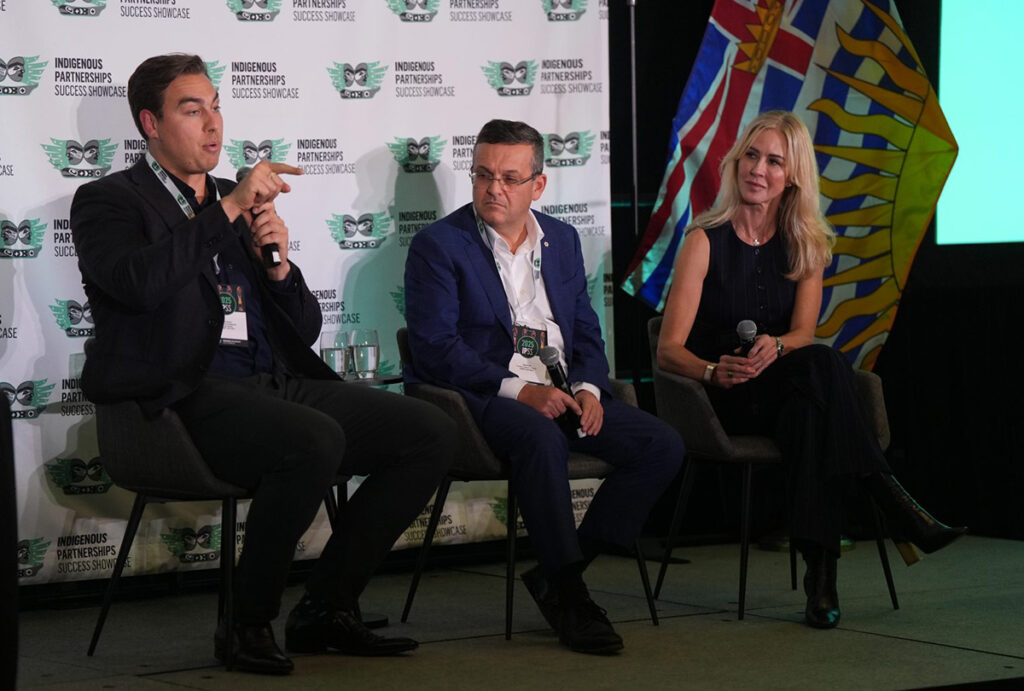
Kody Penner (left), Byng Giraud (centre), and Susannah Pierce (right).
By Resource Works
More News and Views From Resource Works Here
A candid IPSS 2025 panel on financing shared prosperity set out how First Nations, investors and governments can align risk, returns and long term nation building.
At the Indigenous Partnerships Success Showcase 2025 in Vancouver, a late-afternoon panel turned the spotlight to a hard question facing investors and First Nations alike, how to turn global capital and Indigenous equity into real projects that last.
“Financing Shared Prosperity, Global capital, Indigenous equity, real projects” brought together moderator Susannah Pierce, former president and country chair for Shell Canada, with Sedgwick Strategies president Byng Giraud and Nations Royalty vice president of corporate development Kody Penner for a candid discussion on risk, returns, and long term nation building.
Pierce opened by noting that, for many foreign investors, Indigenous participation is still seen as a source of uncertainty, even a perceived risk, rather than what she called “a foundation of investment and opportunity.” That perception, all three agreed, no longer matches reality in British Columbia or across much of Canada.
Giraud argued that today’s assumptions about Indigenous ownership and benefit sharing are the product of decades of work by leaders in communities, business and government. “We are standing on the shoulders of giants,” he said, recalling a time when land acknowledgements were rare and impact benefit agreements were the exception. Indigenous equity is now widely understood as a benefit, not a concession.
Penner, a Tahltan Nation member, traced that evolution through his own territory. Early agreements focused on jobs, he said, but over time they expanded to business opportunities, then to equity and ownership in the infrastructure that surrounds projects. Around the Red Chris mine, he described a “value chain ecosystem” in which the nation now owns and operates power, fibre, an airport, a port and major contracting businesses serving the operation. “If you are mining within the territory,” he said, “you are using our services,” a level of integration that, in his view, materially strengthens social licence.



Both panellists stressed the rapid growth in financial tools that make such arrangements possible, from Indigenous loan guarantees and community infrastructure funds to more sophisticated governance structures and access to risk capital. Those tools, Penner argued, allow First Nations to align agreements with their own long term strategies, whether that means environmental stewardship, seven generation planning, or diversifying local economies.
The conversation quickly turned to “certainty,” a word investors often use when comparing jurisdictions. Giraud cautioned against chasing an illusion. “No project is certain,” he said. Markets shift, politics change, and unexpected events can derail even the best designed proposals. What matters, in his view, is a credible path. Capital “is like water,” he said, it will simply “flow around the rocks” if obstacles look insurmountable. A clear route through the regulatory system, backed by a suite of options Indigenous partners can use, is more valuable than any promise of risk-free approvals.
Penner linked that path directly to community readiness. Nations with investment policies, governance capacity and defined risk appetite can move more confidently into equity or revenue sharing, he said. Others may be better served by royalties or joint ventures rather than owning a direct stake. Equity “sounds good,” he warned, but “has a lot of responsibility,” including exposure to cost overruns and price swings. For many nations, top line revenue agreements can be less risky and easier to align with long range social goals.
The panel highlighted concrete success stories that would have been hard to imagine a decade ago. Giraud pointed to the recent transaction that saw 38 First Nations acquire a 12.5 percent interest in a major British Columbia gas pipeline, an asset that has crossed their territories for decades. The deal relied on an Indigenous loan guarantee program to secure hundreds of millions of dollars in financing at attractive rates, delivering what he called “pension grade” returns without upfront cash from the nations.
Penner offered a more “micro” example from the Yukon, where Selkirk First Nation bought the assets of the bankrupt Minto mine, then helped recapitalise a new public company to redevelop it. The nation now holds a significant stake of the company, with board representation and deep involvement from its development corporation. Because both sides have risk capital in the project, he said, they share in value creation as the mine is de-risked and advanced through new study phases.
Nations Royalty itself is structured as a majority Indigenous owned public company. Penner said its founding nation set a clear goal, to become economically independent of government transfers by building an asset base on the scale of leading North American Indigenous funds. That kind of vision, he argued, can unify communities behind complex financial decisions, because people can “see what it means” in terms of services, education and opportunity for future generations.
Asked what changes would most accelerate similar partnerships, Giraud argued that culture and people matter more than any tweak to environmental assessment statutes. Processes alone do not build projects, he said, teams do. Successful projects depend on people with the right temperament, collaborative mindset and staying power on all sides, in companies, governments and First Nations.
In closing, Pierce returned to relationships. Successful proponents, she said, treat transparency as “the currency of trust,” ensuring community leaders hear good and bad news directly and early. Giraud distilled his final lesson to something simple, “It is about people, the relationships you have across the table.” Penner added that redefining and aligning visions, for nations, companies and governments, remains the essential work. The financial tools now exist, he said, and if they are used well, “shared prosperity” can move from slogan to balance sheet reality.
Share This:





















COMMENTARY: Ottawa Provides Glimmer of Hope and Streamlines Review Process for Energy Projects