CDN NEWS |
  US NEWS







By Deidra Garyk
PART I
After months of pundit predictions, economic anxiety, and Western frustration reaching a breaking point, Canadians went to the polls in April and, despite confident predictions, chose continuity over change. They favoured the Liberals’ new leader Mark Carney over Conservative Party leader Pierre Poilievre.
The irony? A man long associated with global climate orthodoxy now presides over the most significant opening for hydrocarbon development in more than a decade. What changed wasn’t “The Science” or “The Politics”, it was Canadians’ tolerance for policies that ignore the gravity of our economic circumstances and the importance of energy security. That shift is why this year’s energy story reads nothing like the last ten.
Mark Carney’s victory, assumed to signal more of the same climate orthodoxy, did the opposite. It opened space for conversations Ottawa had refused to entertain for years. Suddenly, new pipelines, regulatory resets, and unapologetic discussions about national prosperity weren’t fringe. They were on the table. For a country starved of realism in its energy debates, that shift mattered. However, it may have all been an illusion.
CANADA’S POLICY SHIFTS?
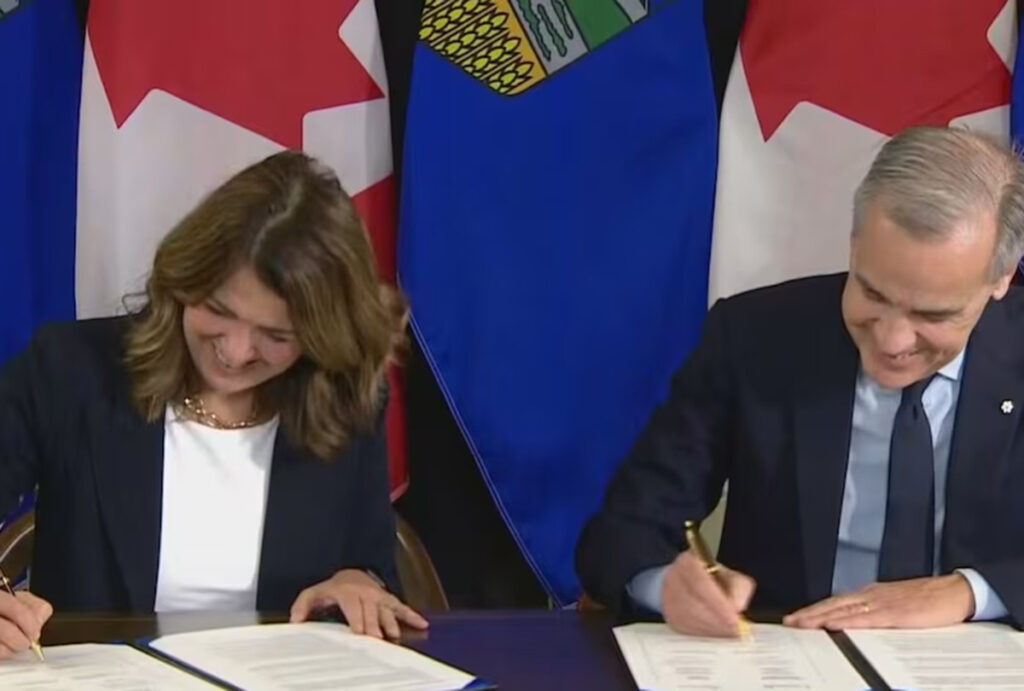
Perhaps the most seismic policy shift came on November 27, 2025, the day that Ottawa and Alberta signed a memorandum of understanding (MOU). The MOU is intended to create an opportunity to explore a new privately funded, one million barrel a day bitumen pipeline to the BC coast, aimed at diversifying exports to Asia.
The MOU scraps the Trudeau-era oil and gas emissions cap and immediately suspends the Clean Electricity Regulations in Alberta – both are huge wins. In exchange, Alberta agrees to raise its industrial carbon price to $130/tonne and advance the Pathways Alliance CCUS pipeline, projected to be the world’s largest.
The MOU signals a cultural shift in Canada. Only months ago, the discussions that led to the MOU would not have been possible; in fact, it would have been inconceivable to think that the federal government would enter the negotiating room, let alone negotiate with Alberta to get to a mutually agreeable endpoint.
Even if I would have liked more concessions by Ottawa, namely the permanent repealing of several ineffective and destructive climate and energy policies, after reading the MOU, I think the negotiated outcome is better than I could have hoped for. The MOU goes beyond an oil pipeline and broadly addresses future energy development, including nuclear and electricity interties.
The MOU is a political statement of intent; it is not a guarantee that the pipeline will be built. Much depends on private-sector investors, regulatory clarity, and buy-in from the BC government, along with affected Indigenous communities. These groups do not get a veto, but consultation is required, and that will not be easy.
A twist came on December 9, a week and a half after publicly declaring their support for a new, interprovincial oil pipeline and their willingness to lessen certain climate-related rules, the Carney Liberals, along with the Bloc, the NDP, and the Greens, voted against the official opposition’s motion to support the construction of one or more pipelines to BC.
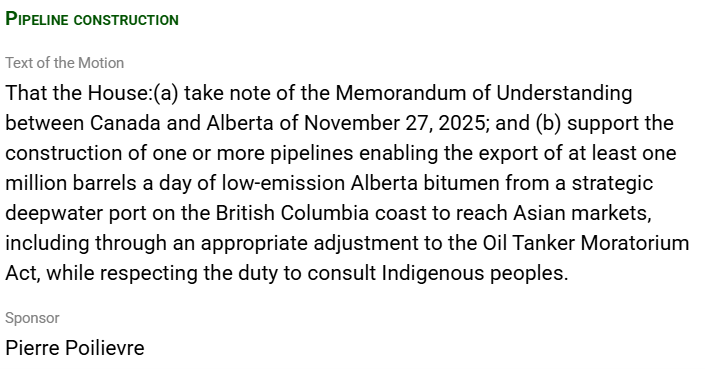
The Liberals claim the motion is merely a political game being played by the Conservatives. Yet, it calls the credibility of the entire MOU negotiation into question, creating uncertainty. Did Carney negotiate in good faith? Will the government declare the pipeline a “project of national” interest, speeding up approval by exempting it from some federal laws, as promised? Does this vote expose fissures in the Liberal caucus or did the MOU create false hope that Canada would become an energy superpower under Carney’s leadership?
Another unexpected outcome of the MOU is that it “triggered” former ECCC minister Steven Guilbeault, who decided to take his ball and go home, resigning from cabinet, but not from his position as MP in the Liberal caucus. This leads me to believe that the MOU was negotiated in somewhat good faith, otherwise Guilbeault would have no reason to resign in protest if he knew that a pipeline would never be built.
Remember when the Minister of Misinformation said in May that the TMX pipeline was operating at “about 40 per cent capacity.” If I could offer him some sage advice from 80’s glam rockers Motley Crue: Steven, don’t go away mad; Steven, just go away!
Despite signing the MOU, the feds remain steadfast in their commitment to achieving climate goals, while simultaneously appearing to support the build out of hydrocarbon infrastructure. The usual suspects – the climate activists – are unsurprisingly, deeply disturbed by the MOU.
Frequent purveyor of oil and gas misinformation, Guilbeault claimed on CTV’s Power Play that his party is lying to Canadians about the ease of achieving their climate goals. I wonder how long he will remain in caucus?… but I digress.


Environmental groups have criticized the rollback of methane and emissions cap regulations as a step backward for Canadian climate commitments. The possibility of loosening the tanker ban restrictions, known as Bill C-48, have attracted much of the ire of the activists.
Green Party MP Elizabeth May, Minister of Misinformation-in-waiting, posted a “fact check” PSA, insisting that tankers do not pass through the Hecate Strait. Unfortunately, her “facts” would not pass a Facebook fact check, as this article in The Hub makes clear.
Probably one of the most deceptive tactics used to keep the tanker ban in effect is the repeated claim that coastal First Nations oppose oil tanker traffic on the West Coast. The official-sounding “Coastal First Nations” is often presented as if it were an authoritative coalition representing West Coast indigenous communities. It is not. It is a Vancouver-headquartered, well-funded ($28,367,877 in assets) activist group that lazy journalists, often activists themselves, quote when they want to “prove” that all indigenous people along the West Coast are opposed oil tankers. For more information on the group’s funding, much of it from tech philanthropy organizations outside of Canada, read the piece of Stewart Muir of Resource Works here.
I’ve often wondered why American philanthropic organizations continue to fund climate activism in Canada to the tune of millions of dollars each year. I saw this clip from a podcast with Nicole Shanahan, ex-wife of a former Google founder and someone who lived in that world, and it helped me understand the mindset. Her hypothesis explains the allure of virtuous philanthropy wrapped up in personal purpose. She claims social justice and climate change get progressive women 100 percent of the time. It’s not conspiratorial, but it is profoundly misguided.
LNG MILESTONES
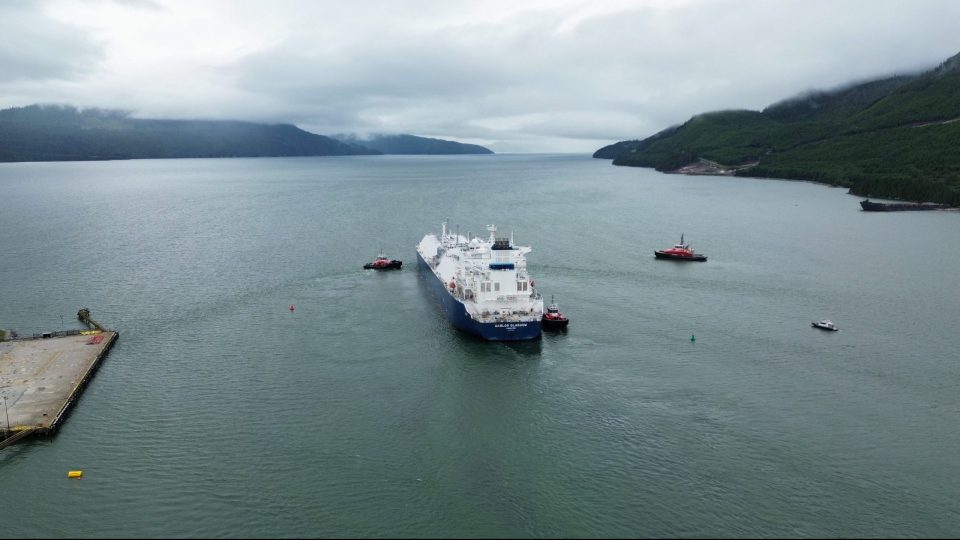
Liquified natural gas remained a top story in Canada. Natural gas is no longer being considered just a “bridge fuel”, implying that it will phase itself out; with the power demand of data centres, it’s being called on to be a central fuel of choice. Who knew the enviro-focused tech bros would be the reason behind a resurgence of natural gas demand?
LNG Canada shipped its first cargo from Kitimat, BC, on July 1, 2025, marking Canada’s entry into global LNG markets. By September, the terminal had exported over 38 billion cubic feet of gas.
Canada’s approval of LNG facilities has been slow compared to other gas-producing countries, but we are making progress. Note that Canada does not have any LNG import terminals and all new projects are export facilities, including:
- Woodfibre LNG’s (Squamish, B.C.) construction is more than 50 percent complete, with start-up expected in 2027.
- Cedar LNG, a Haisla Nation–Pembina Pipeline partnership, advanced construction and signed a 20-year deal with Malaysia’s PETRONAS. This facility is expected to be operational in 2028.
- Nisga’a Nation’s Ksi Lisims LNG has been fast-tracked as a $56 billion nation-building project, and will be referred to the Major Projects Office.
TRADE TENSIONS
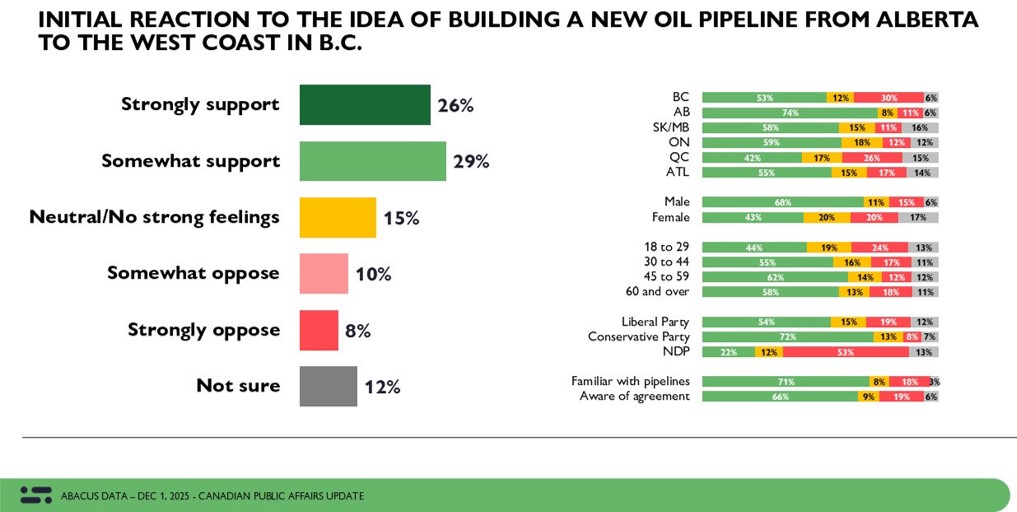
We could not adequately summarize the year, in the energy sector and beyond, without talking about US tariffs and the impact on trade. US tariffs on Canadian energy (10%) and goods (25% on steel and aluminum) reshaped Canada’s energy strategy toward Asia. A desire to diversify trade away from the US may be bolstering support for an oil pipeline to the West Coast, with 55 percent of respondents to a recent Abacus Data poll in support and only 18 percent opposed. Who guessed that Trump would end up being the reason a majority of Canadians support a pipeline?
Canada’s exports to the US are approximately $42.9 billion per month or 74 percent of total trade, compared to $15.2 billion with the rest of the world. Because we are a contiguous landmass, the Americans remain a valuable trading partner and maintaining diplomatic relations with them is imperative.
Claims by the Americans that they do not need Canada’s oil are simply false. Ninety eight percent of Canadian crude exports are shipped to the US, and their heavy oil refineries need our heavy oil to blend with lighter crudes. Perhaps this is why President Trump says he wants the Keystone XL oil pipeline project revived.
However, it will be imperative to watch the US’s relationship with Venezuela over the coming months because their heavy crude could cause disruption in the Canadian market, hence the need to expand export infrastructure and diversify our trade.
Energy consumption continues to rise globally, and hydrocarbons remain the largest contributor to the mix. Yet, uncertainty and unpredictability plague the Canadian energy sector.
Over 20 years in the Canadian energy sector, Deidra held key roles, where she focused on a broad range of initiatives, from sustainability reporting to fostering collaboration among industry stakeholders through her work in joint venture contracts.
Outside of her professional commitments, Deidra is an energy advocate and a recognized thought leader. She is passionate about promoting balanced, fact-based discussions on energy policy, and sustainability. Through her research, writing, and public speaking, Deidra seeks to advance a more informed and pragmatic dialogue on the future of energy.
Share This: