


 CDN NEWS |
  US NEWS







A political moment that shows British Columbians are already embracing a more pragmatic energy future
By Stewart Muir
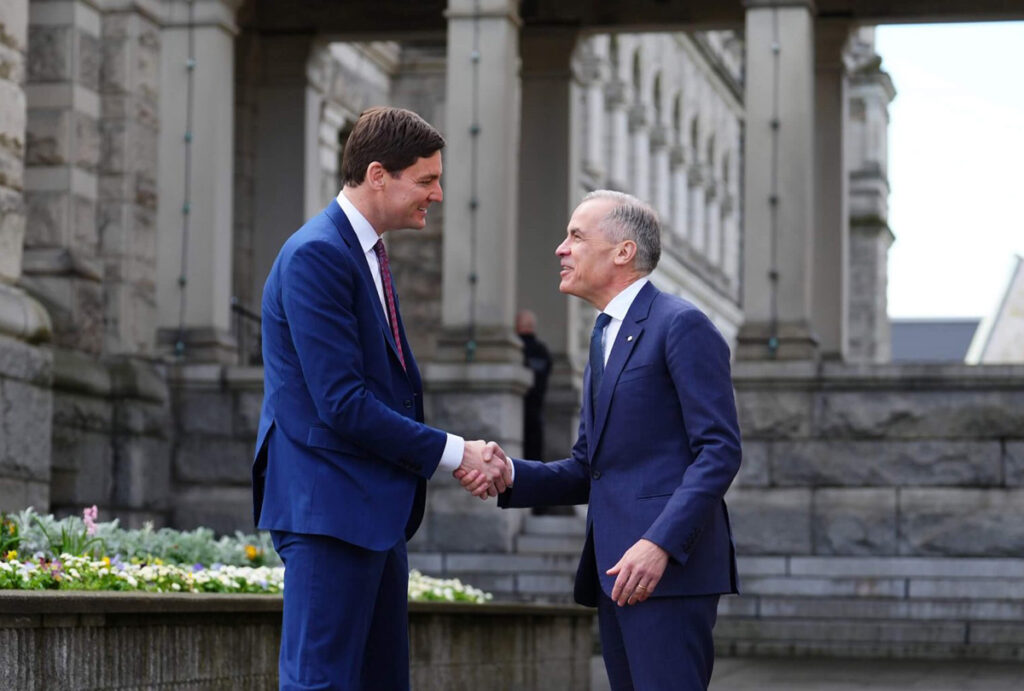
Prime Minister Carney meets BC Premier Eby at the BC Legislature Assembly in Victoria. THE CANADIAN PRESS/Sean Kilpatrick
By Resource Works
More News and Views From Resource Works Here
With the news of CleanBC’s long-awaited review landing this week — and instantly swept aside by the far more consequential Carney–Smith energy pact unveiled in Calgary — it’s worth stepping back to examine what’s really happening inside British Columbia’s energy story.
To begin with, the CleanBC review was never going to shock anyone. A panel composed largely of the program’s original authors has now reviewed its own legacy and pronounced it a success. “Stay the course,” they conclude, as though hydro reservoirs were brimming, transmission lines sprouting and winter peak demand politely declining.
But the political reality on the ground tells a different story — and in fairness to the B.C. government, they seem increasingly aware of it.
Adrian Dix and the return of practicality
One development deserves close attention: the bracingly pragmatic tone emerging from the Ministry of Energy under Adrian Dix. Some will say this belies past positions; others will note that few in government sustain pure idealism once confronted with the unforgiving arithmetic of a real energy system.
Governance is, after all, the art of exchanging ideals for workable solutions — and doing so without losing the thread of public confidence. Dix appears to understand this instinctively. His recent comments suggest a government no longer pretending that electrification can accelerate faster than generation, that LNG can be treated as a marginal distraction or that affordability pressures can be waved away.
It is a realism long overdue — and made more urgent by events unfolding beyond B.C.’s borders.
Carney and Smith reset the national frame
The Carney–Smith pact was a political thunderclap. It signals a federal government now framing energy as industrial strategy rather than moral virtue — LNG, CCUS, nuclear, interties and a western power pool long resisted in Victoria.
British Columbia cannot opt out of this shift. A regional electricity system shaped by Alberta’s nuclear ambitions, carbon frameworks and CCUS hubs will determine our future whether we consent or not.
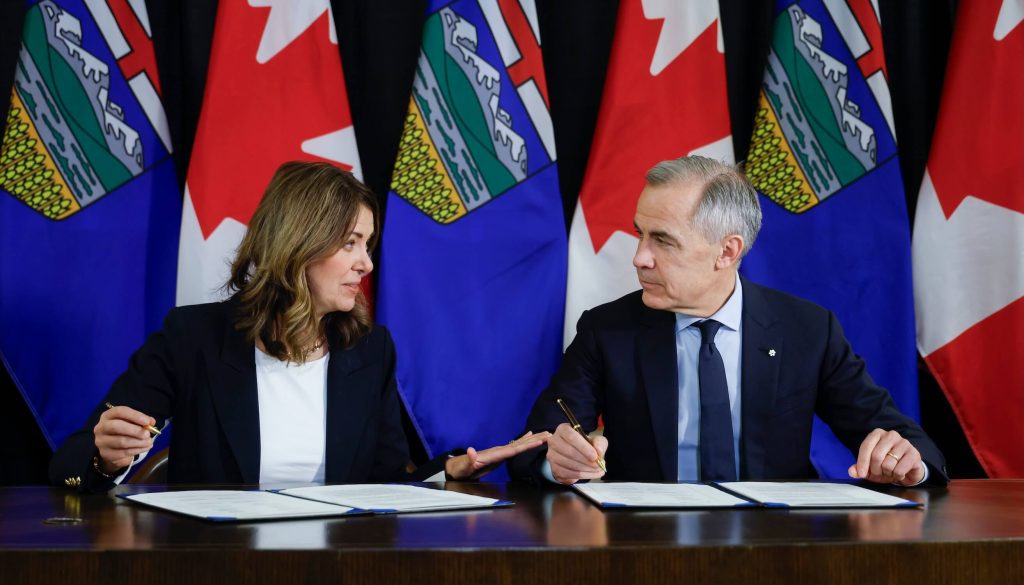
Prime Minister Carney signs MOU with Alberta Premier Smith. THE CANADIAN PRESS/Jeff McIntosh
But here is the deeper point: Carney must urgently bring the B.C. government into his thinking. Not in a heavy-handed way, but in the spirit of shared national purpose. The West is entering a period where continental energy security, climate ambition and trade strategy are intertwined. B.C. needs to be at that table — not orbiting it under the illusion of hydro self-sufficiency.
And it is not only B.C. that must be brought in.
Alberta’s nuclear ambitions are the unexpected easter egg for B.C.
There is one detail in the Carney–Smith agreement that has received almost no attention in British Columbia, but it may turn out to be the single most consequential provision for our province. Buried in the MOU is a sentence that should make every energy planner in Victoria sit bolt upright:
“On or before January 1, 2027, [Alberta will] collaborate with Canada to develop a nuclear generation strategy to build and operate competitive nuclear power generation that can serve the Alberta and inter-connected markets by 2050.”
For most commentators this was a line item. For B.C., it is an easter egg.
Premier David Eby has been admirably frank about B.C.’s structural problem: we do not have the electricity to power the climate and economic ambitions laid out in CleanBC. Every major speech he gives includes the same candid admission — electrification is outpacing the grid, winter peaks are rising and new load is arriving faster than new supply.
Here is the irony no one in Victoria has admitted out loud. The idea that this new MOU somehow undermines B.C.’s green ambitions is exactly backwards. It is precisely because Alberta is moving toward reliable, zero-emission nuclear power that British Columbia may avoid having to say no to the very climate-positive industrial projects Eby champions.
Alberta’s nuclear strategy is not a threat to B.C.’s climate identity. It is the only credible long-term solution to our electricity shortfall that does not involve backsliding into diesel generation, rationing clean projects or throttling economic growth. When Alberta commits to building nuclear that can “serve the inter-connected markets,” it is implicitly offering B.C. access to clean firm power we cannot produce ourselves at the scale required.
In other words, Alberta has handed Premier Eby the one political gift he could never give himself: the ability to approve more clean-energy projects, not fewer. A path to keep B.C.’s climate agenda alive without the arithmetic collapsing under its own ambition.
This single sentence in the MOU may prove to be the most important one — hiding in plain sight, waiting for British Columbia to notice.


A new trade order demands full Indigenous partnership
The coastal First Nations — from Haida Gwaii to Heiltsuk to Haisla — have as much at stake in this emerging framework as any provincial capital or federal ministry.
For generations, these communities have shouldered the consequences of a maritime system they did not design, whether it is:
- rudderless Russian vessels drifting dangerously toward Haida Gwaii
- the steady procession of Alaska oil tankers off our coast
- whatever commercial risks emerge as Canada navigates a Trumpian global order nobody requested
The uncomfortable truth is that Canada’s Pacific future cannot be defended, economically or environmentally, without Indigenous nations exercising full responsibility and full participation.
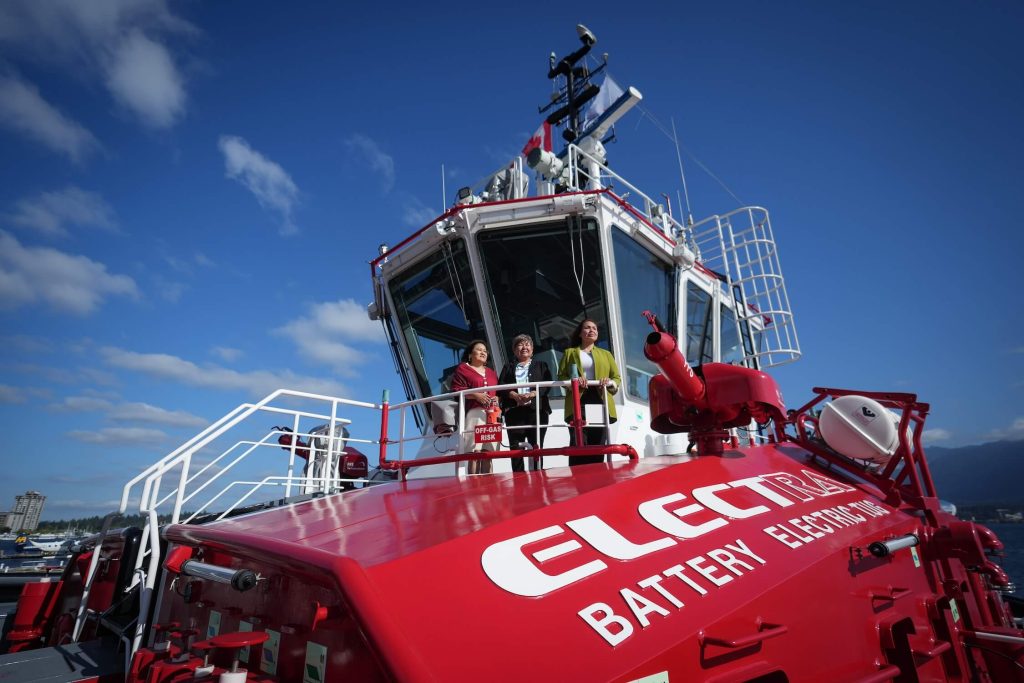
Indigenous leaders aboard the HaiSea Wamis electric tug. THE CANADIAN PRESS/Darryl Dyck
This is not merely a moral argument (though it is that). It is a strategic necessity.
The coastal nations stand to gain something they were too long denied: stability, prosperity and the end of a shameful legacy of child poverty — through participation in maritime protection, stewardship and the infrastructure that accompanies a modern trading nation. And the 200 other First Nations in British Columbia will also benefit from this.
An energy and trade framework built for the 2030s must weave Indigenous economic leadership and environmental guardianship into its very structure. Carney cannot afford to treat this as an afterthought. Nor should he want to.
A fresh page for energy and environment
And there is one more context British Columbia should not ignore. The era of energy and environment in Canada is dawning just as the long, scolding day of Steven Guilbeault’s zealotry drew to its sharp and widely welcomed end with his huffy departure from federal cabinet on Thursday. His exit is not simply a political footnote. It marks a pivot away from an absolutist, lecture-driven approach to climate policy and toward a more balanced, practical and innovation-driven one.
For British Columbia, this is the moment to do the obvious thing — the thing that has been staring us in the face for a decade. If we are serious about solving our energy constraints, and if we truly want to maintain the green ambitions Premier Eby talks about, then we must responsibly and innovatively pursue the energy options already under our control. At the very top of that list is the immense, world-class natural gas resource of northeastern B.C.
Natural gas is not a detour from a clean economy. It is the backbone that keeps the system upright while we build the future. The Montney shale gas formation is not an embarrassment to be tiptoed around; it is the strategic endowment that can power our society forward, stabilize the grid, fund emissions reductions and support the clean industrial projects British Columbians say they want. Any honest reading of the province’s energy arithmetic leads to the same conclusion: B.C.’s path to a credible clean-energy future runs directly through the responsible development of its natural gas wealth.
The public is already there
Fortunately, the Energy Futures Institute’s partnership with Ipsos gives us a clear picture of British Columbians’ thinking. The early fall 2025 survey shows a public far more pragmatic than the dogmatic energy debates of earlier years.
British Columbians want energy choice:
- 63% support allowing natural gas or electricity for heating, rejecting municipal bans.
- 62% support building new LNG export facilities.
- 52% support including LNG’s displacement effect on coal in B.C.’s climate accounting.
- 54% support delaying emission-reduction deadlines due to electricity constraints.
This is a public that understands complexity, values reliability and supports Indigenous economic participation far more than the caricatures suggest.
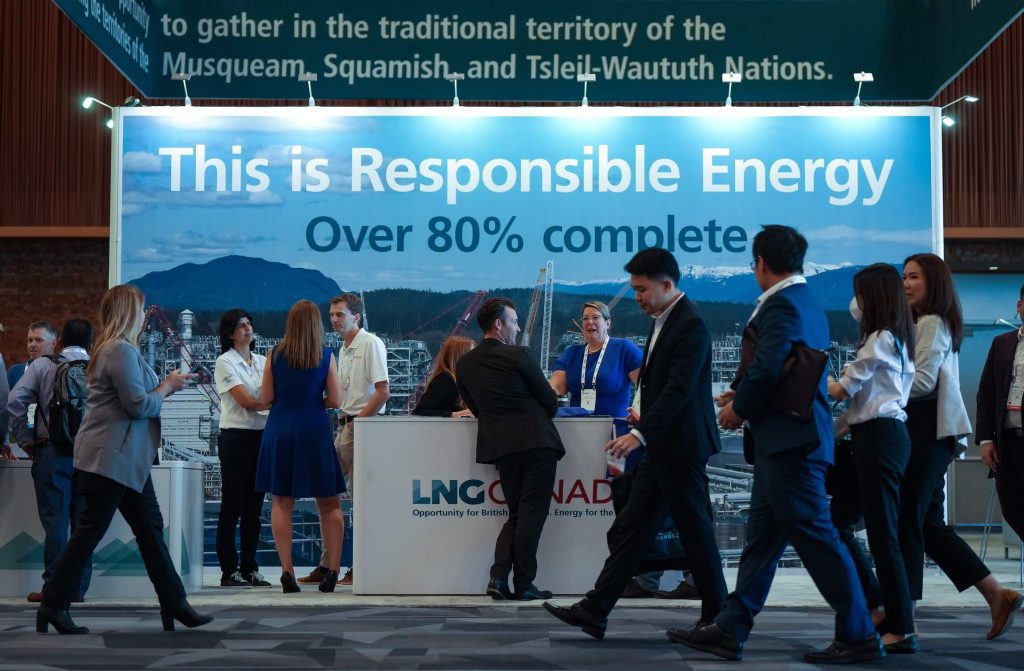
Visitors pass the LNG Canada booth at LNG2023 in Vancouver. THE CANADIAN PRESS/Darryl Dyck
CleanBC’s review never stood a chance
Which brings us back to the CleanBC review. It did not fall flat because of poor intentions or bad work. It fell flat because the context has changed. The public has moved on. The federation has moved on. Even the provincial government is showing signs of adapting.
CleanBC was built for a world where B.C. lived inside an energy bubble — hydro-dominant, insulated and capable of electrifying all things simultaneously. That world is gone.
We are entering an era where electricity scarcity is real, LNG is strategic, interties matter, Indigenous co-governance is essential and trade routes carry geopolitical risks that will not manage themselves.
The CleanBC review says “stay the course.” It says treat the solution (natural gas) as if it was the problem.
Everything else — public sentiment, federal priorities, Indigenous expectations, real-world constraints — says the course has already changed.
The real story
British Columbia now stands inside a national and geopolitical realignment. Adrian Dix’s emerging pragmatism is a necessary ingredient. Carney’s continental framing is unavoidable. And Indigenous nations must not simply be consulted — they must be partners with full economic, environmental and maritime responsibility.
British Columbians see this.
The Ipsos data confirms it.
And the province is beginning, quietly, to act as though it understands it too.
That is the most hopeful development of all.
Share This:





















INSIGHT: Canada’s Natural Resource Sector is at the Heart of the Government’s ‘Export & Diversification’ Plan