CDN NEWS |
  US NEWS







Canada’s sudden rediscovery of energy ambition has been greeted with a familiar charge: hypocrisy
By Stewart Muir
By Resource Works
More News and Views From Resource Works Here
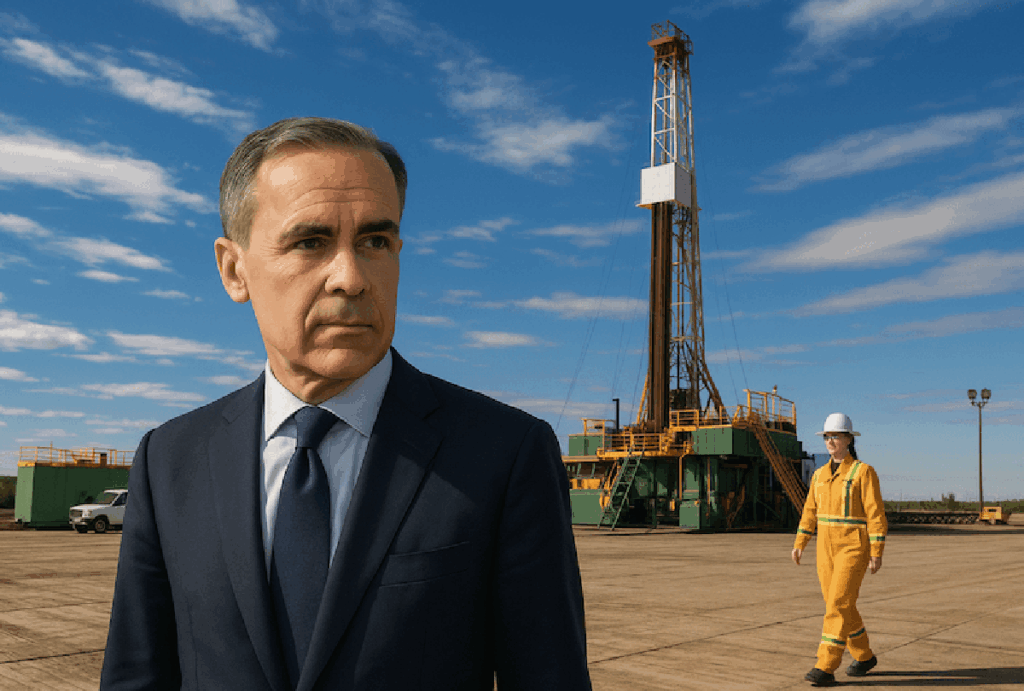
How, critics ask, can Mark Carney – former climate envoy, central banker and champion of decarbonization – now endorse LNG expansion and pipelines?
The short answer is that Canada ran out of room for fantasy.
This is not a conversion story. It is a collision between aspiration and a world that no longer indulges it.
The world changed. Canada had to respond
Canada is now in an economic fight with its largest trading partner. Tariffs aimed at manufacturing are not abstract policy tools. They are pressure points. When the U.S. signals it can do without Canadian goods, dependency turns from convenience into risk.
In that environment, energy is not just another file on the minister’s desk. It is leverage.
Oil & gas remains Canada’s strongest economic asset. Suppressing that advantage while competitors entrench theirs is not moral leadership. It is strategic self-harm.
Carney did not abandon climate goals. He reordered priorities – something serious leaders do when conditions change.
What we don’t know – yet
It is also worth acknowledging what we cannot see.
We do not know the internal conversations Carney has had with himself as the world hardened around him. We do not know how he weighed climate ambition against economic vulnerability, or how reluctantly – or decisively – he concluded that this pivot was unavoidable.
Perhaps, at some point, he will choose to set that out plainly in a major speech. If he does, many people in Canada and around the world will respect him for it. There is no shame in explaining how changed circumstances force changed choices.
For now, we can only take the situation at face value – and judge it on its merits.
LNG is not the climate villain some people pretend it is
Much of the outrage rests on a comforting illusion: that if Canada restrains itself, global emissions will fall.
They won’t.



In Asia, the choice is not between gas and renewables. It is between gas and coal. China is expanding coal use aggressively, not accidentally. Canadian LNG displaces coal at the margin. That is a climate gain, however inconvenient it may be for absolutists.
A poorer Canada does not save the planet. It simply exits the game.
You can’t transition from an economy you’ve dismantled
Hydrocarbons still supply roughly 80 per cent of global energy. Food, cement, steel, plastics and heavy transport all depend on energy density. This is physics, not ideology.
Canada’s mistake over the past decade was not caring about the environment. It was confusing ambition with sequencing – trying to jump off hydrocarbons before a replacement was ready.
The result was stagnation, investor flight and growing regional tension inside a fragile federation.
Energy revenues are not the enemy of transition. They fund it.
Energy abundance is a defence, not a sin
There is a reason energy-poor societies become unstable. Scarcity feeds populism, grievance and fragmentation. Abundance buys time, options and resilience.
Carney now governs in a colder world – one defined by trade conflict, bloc politics and rising insecurity.
Middle powers that fail to defend their economic base don’t lead. They get pushed around.
This pivot is not about loving fossil fuels. It is about keeping Canada solvent, united and relevant long enough to build what comes next.
Grown-up choices are rarely applause lines
Politics built on virtue signalling is easy. Politics built on delivery is not.
Prime Minister Carney’s turn to energy development is not a betrayal of climate concern. It is an admission that good intentions without economic strength lead nowhere.
Some will question why I’m trusting Carney to prove he has the courage of his stated convictions. Who’s got a better idea than seeing where this goes?
Rome wasn’t built in a day. And it wasn’t defended by people who mistook ideals for infrastructure.
Share This: