


 CDN NEWS |
  US NEWS







At IPSS 2025, Woodfibre LNG’s CEO and Chief Ian Campbell urged deep listening, consent, and high standards as the path from one project to a real industry.
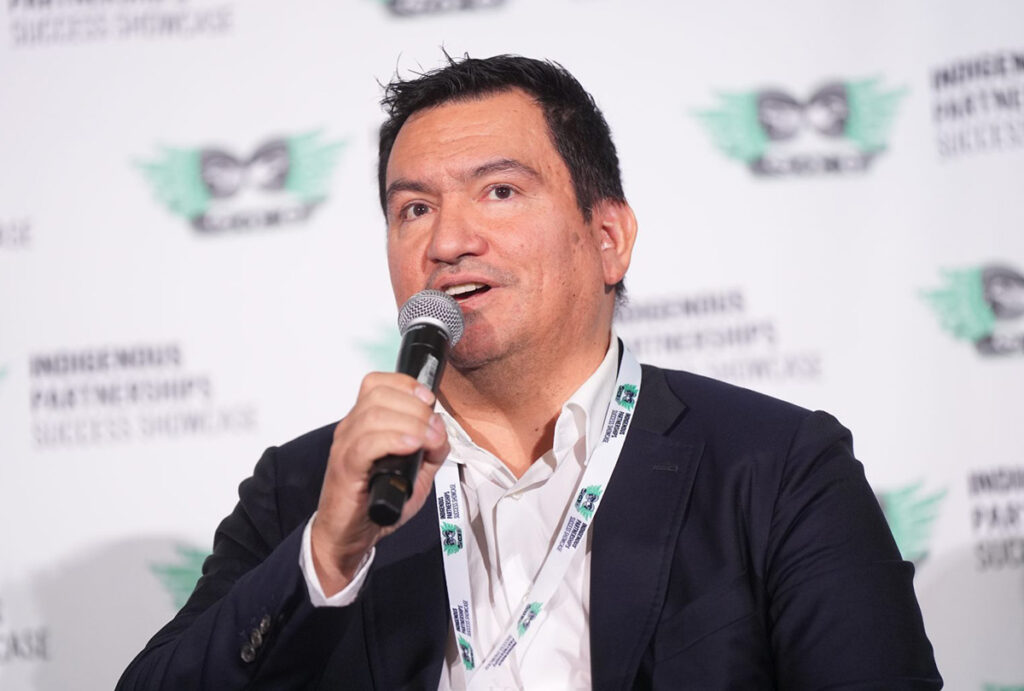
Nov 13. – Resource Works IPSS 2025. Photo credit Resource Works or Resource Works/LTB Productions.
By Resource Works
More News and Views From Resource Works Here
At the Indigenous Partnerships Success Showcase on Nov. 13, Woodfibre LNG chief executive Luke Schauerte and Sḵwx̱wú7mesh Úxwumixw (Squamish Nation) Hereditary Chief Ian Campbell sketched a practical blueprint for Indigenous–industry partnership: start with the Nation’s authority, build certainty through consent, and deliver measurable progress on the ground.
Campbell, who helped design the Squamish Nation’s first-of-its-kind, binding Indigenous environmental assessment for Woodfibre LNG, framed the relationship’s origin point plainly: “So the Squamish Nation opted to conduct our own environmental assessment.” That process, he said, began with community priorities. “That’s really where we started, is deep listening to our community members,” Campbell told the audience, adding that the goal was to move beyond consultation to clarity: “We really wanted to move towards consent, so that was really the crux of why we engaged and began the journey together.”
Campbell situated the project at Swiy̓át, a historic Squamish village site later occupied by a pulp mill. “This village was removed from us in the early 1900s around 1905 and used as a brownfield for over a century,” he said, describing how the Nation’s regulatory leadership helped drive remediation and higher standards at the site. (In a recent reflection published ahead of IPSS, Campbell called the partnership “reconcili-ACTION,” and noted the Nation’s role as a recognized regulator with legally binding conditions for the project.)
Execution at scale — and a new competitive standard
Schauerte, who became CEO of Woodfibre LNG in November 2024 after senior roles at LNG Canada and Shell, picked up the thread by focusing on execution and scale. He described Woodfibre LNG as “a 2.1 million ton per annum export facility that will connect Canadian markets to Asian markets,” and offered a construction snapshot: “Currently we’re at 55% construction… We’ve received 12 out of our 19 modules, you’re seeing us go vertical.” The facility, now under construction at Swiy̓át near Squamish, began major works in September 2023 and is slated for completion in 2027.



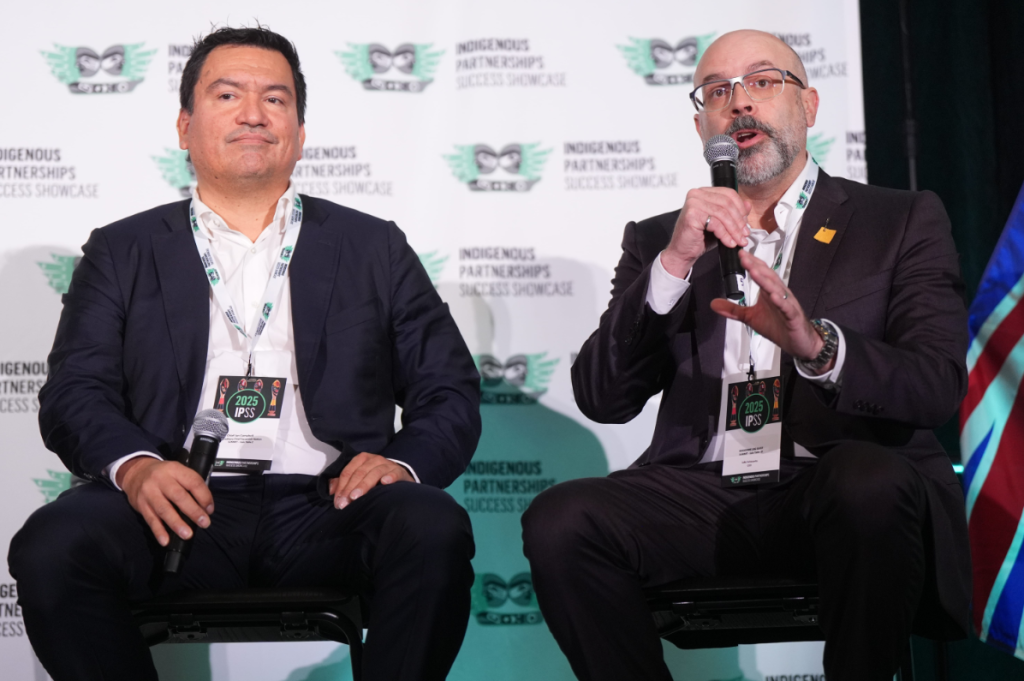
Woodfibre LNG chief executive Luke Schauerte and Chief Ian Campbell on the stage at IPSS.
The through-line of both speakers was that durable partnerships are built into the project’s design. Campbell emphasised the Nation’s regulatory seat at the table as a way to bridge knowledge systems and lock in accountability across the project’s life. Schauerte pointed to that same architecture as a competitive advantage, describing how co-developed standards, gender-safety commitments and environmental safeguards create certainty for investors, governments and communities alike.
From one project to an industry
Much of the conversation turned on how partnerships can scale beyond one facility. Schauerte argued that a handful of successful West Coast projects, executed to high standards and in partnership with Indigenous governments, can tip Canada from one-offs to a true industry. “I think the second one for me is that Canada is an energy superpower,” he said of the coming decade, casting Woodfibre as part of a broader lift that includes Indigenous equity, local procurement and long-term careers.
Campbell, who has served as an elected councillor and lead negotiator for the Squamish Nation, underlined that the model’s legitimacy rests on clear consent and benefits that flow to people over time. The first principles, he suggested, have not changed: the Nation defines the terms, decisions are grounded in both traditional and Western knowledge, and partners are held to commitments on environmental performance, safety and jobs.
Early engagement sets the tone for decades
If the keynote had a message for project proponents, it was that the first months set the tone for the next forty years. That means showing up early, listening first, and being prepared to adapt the project to the place, from on-land design choices and air-cooling to strong worker-housing solutions and site remediation. It also means accepting a high bar from B.C. regulators and Indigenous authorities as a feature, not a bug, of earning consent and capital. By the end of the session, the pair had offered a simple test for success: build a facility that meets world-class standards because the Nation helped write them, prove that prosperity and stewardship go together, and leave a site and a relationship better than you found them. As Campbell put it, the journey began with deep listening. The proof, Schauerte suggested, will be in what gets built, and how.
Share This:






















On The Verge: Energy Sector Primed for New Wave of Growth – ATB Economics