


 CDN NEWS |
  US NEWS







It should not take a crisis for Canada to develop the resources that make people and communities thrive.
By Geoff Russ
By Resource Works
More News and Views From Resource Works Here
Canada is suddenly sprinting to build things it slow-walked for a decade.
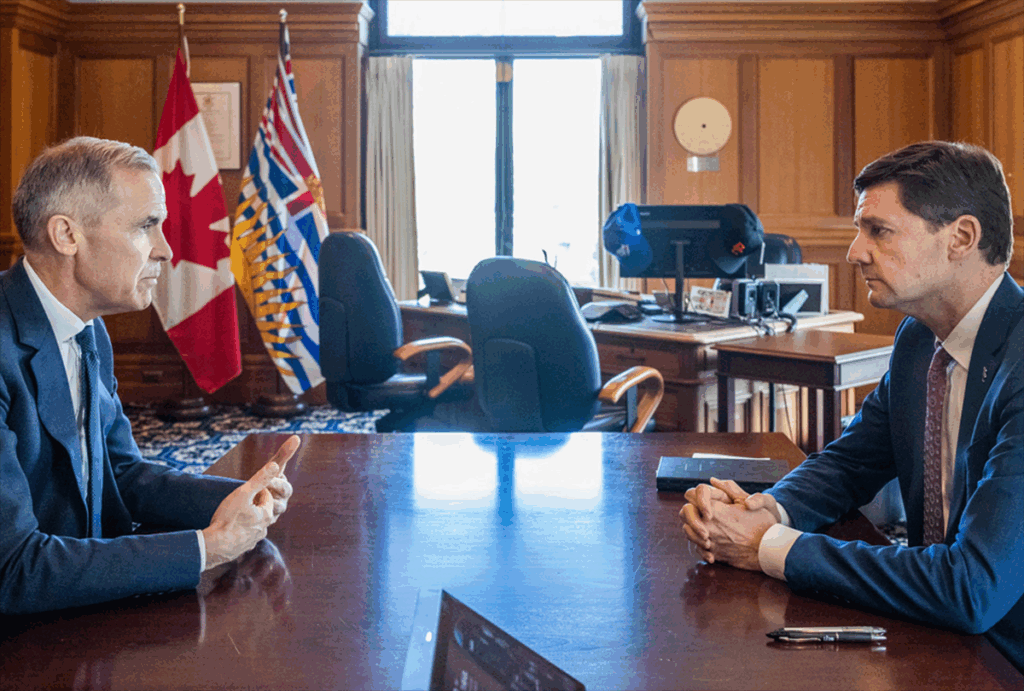
“Canada has always been a nation of builders, from the St. Lawrence Seaway to Expo 67. At this hinge moment in our history, Canada must draw on this legacy and act decisively to transform our economy from reliance to resilience. We are moving at a speed not seen in generations,” announced Prime Minister Mark Carney at the end of August.
He was echoed by British Columbia Premier David Eby shortly after.
“There’s never been a more critical time to diversify our economy and reduce reliance on the U.S., and B.C. is leading the way in Canada, with clean electricity, skilled workers and strong partnerships with First Nations,” the premier stated after his government approved the Ksi Lisims LNG project, led by the Nisga’a nation.
In the face of President Donald Trump’s tariffs, Ottawa has unveiled a first wave of “national projects” that includes an expansion of LNG Canada to 28 million tonnes a year, a small modular reactor at Darlington, two mines, and a port expansion, all pitched as a way to “turbocharge” growth and reduce exposure to a trade war with the United States.
The list notably excludes new oil pipelines, and arrives with rhetoric about urgency and nation-building that begs a simple question: why did it take a crisis to prioritise what should have been routine economic housekeeping?
The most tangible impact of resource projects can be observed in the impact it has on communities. The Haisla Nation is enjoying an economic renaissance with their involvement in the LNG Canada project on their traditional lands, which became operational in June.
Furthermore, the Haisla are set to unveil their own facility, Cedar LNG, in 2028. Already, the impact of employment and strong paycheques in the community is transforming, as former Haisla Chief Councillor Crystal Smith as attested many times.


“Let’s build a bright and prosperous future for every Canadian and every Indigenous person that wants to be involved, because change never happens inside of our comfort zones, or the defensive zone,” said Crystal Smith at a speech delivered to the 2025 Testimonial Dinner Award on April 24 in Toronto.
Fortunately, the new pro-resource posture has a legislative backbone. Parliament passed the One Canadian Economy Act to streamline approvals for projects deemed in the national interest, a centrepiece of the government’s plan to cut internal trade barriers and fast-track strategic infrastructure.
Supporters see it as necessary in a period of economic rupture, while critics warn it risks sidelining Indigenous voices in the name of speed. Either way, it is an admission that Canada’s previous processes had become self-defeatingly slow.
British Columbia offers a clear case study. Premier David Eby is now leaning hard into liquefied natural gas. His government and Ottawa both approved the Nisga’a Nation-backed Ksi Lisims LNG project under a “one project, one review” approach, with Eby openly counting on the Nisga’a to build support among neighbouring nations that withheld consent.
It is a marked turn from earlier NDP caution, framed by the premier as a race against an American Alaska LNG push that could capture the same Asian markets.
Yet the pivot only underscores how much time was lost. For years, resource projects faced overlapping provincial and federal hurdles, from the Impact Assessment Act’s expanded federal reach to the 2018 federal tanker ban on B.C.’s north coast.
Within B.C., a thicket of regulations, policy uncertainty, and contested interpretations of consultation obligations chilled investment, while political positions on pipelines hardened. Industry leaders called it “regulatory paralysis.” These were choices, not inevitabilities.
The national “go-fast” stance also arrives with unresolved tensions. Ottawa has installed a Calgary-based office to clear and finance major projects, led by veteran executive Dawn Farrell, and is touting the emissions performance of LNG Canada’s expansion.
At Resource Works, we wholeheartedly endorsed the move, given the proven ability and success of Dawn Farrell in the resource industry. It must also be acknowledged that the major projects office will only be an office unless it meaningfully makes these projects happen faster.
A decade that saw eighteen B.C. LNG proposals produced one major build, and moving to LNG Canada’s second phase is entangled with power-supply constraints and policy conditions. That slow cadence is how countries fall behind.
If the current urgency becomes a steady habit, Canada can still convert this scramble into lasting capacity. If not, the next shock will find us sprinting again, only further from the finish line.
Share This:






















INSIGHT: Canada’s Natural Resource Sector is at the Heart of the Government’s ‘Export & Diversification’ Plan