


 CDN NEWS |
  US NEWS







Industry waits for the prime minister and the premier to reveal a new energy agreement on Thursday.
By Chris Varcoe
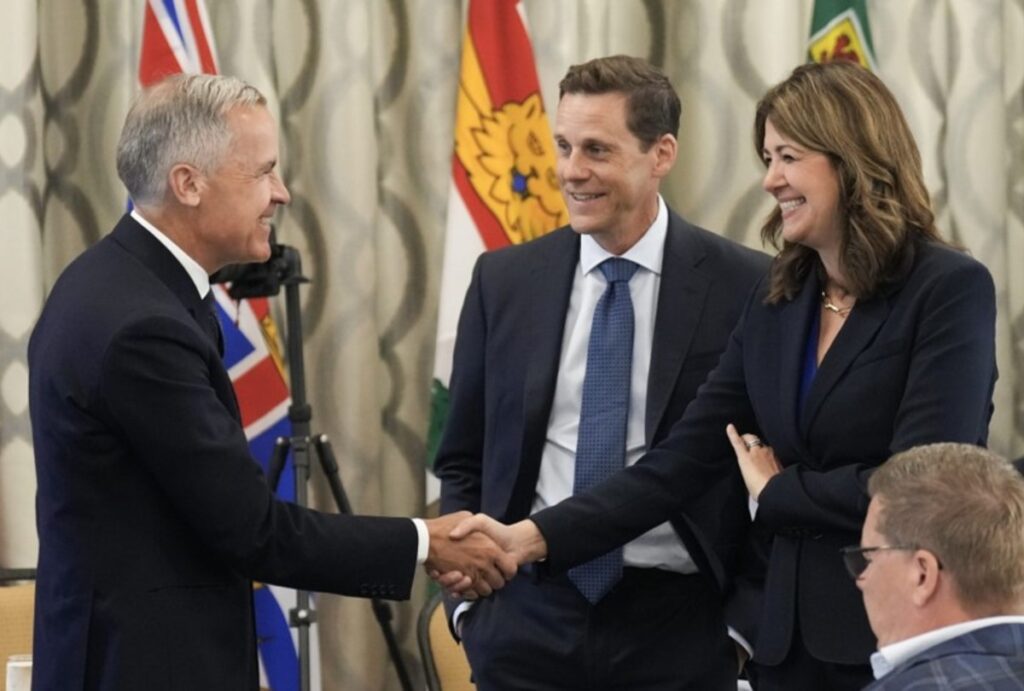
Premier Danielle Smith and Prime Minister Mark Carney will be meeting on Wednesday afternoon ahead of the Liberal National Caucus meeting. Photo by Nathan Denette /Postmedia Network
See this article and more by Chris Varcoe HERE
For the Canadian oil industry, there are growing reasons for optimism about the push to build a new export pipeline and to increase production to fill it.
A memorandum of understanding (MOU) between the Carney government and Alberta that involves a pathway for a new oil pipeline, along with addressing other outstanding energy issues, is expected to be unveiled in the city on Thursday, according to sources.
“It will be a good day for Canada,” said one source.
Across the industry, news surrounding the pact between the two levels of government — first reported by Postmedia’s Rick Bell on Saturday, with further details of the MOU revealed by CBC on Monday — has been watched closely in recent weeks.
“It signals to the world that Canada is, once again, open for business, and bring your capital. We’ve got the resources, let’s see the projects — and let’s go,” said Surge Energy CEO Paul Colborne on Monday.
“I’m thrilled by this news.”
Over the past week, Prime Minister Mark Carney and Premier Danielle Smith both indicated their governments were close to reaching an MOU that would see Alberta propose a new oil pipeline to the Pacific coast. The province wants the development included on Ottawa’s list of major nation-building projects to be expedited for approval.
As part of a “grand bargain” pitched earlier this year by Smith, it would also include a carbon capture and storage network, proposed by the Pathways Alliance group of oilsands operators, moving forward, helping decarbonize its production.
The MOU is expected to include an understanding about key federal energy and environmental policies — such as the Clean Electricity Regulations — and the province’s industrial carbon levy, which is frozen at $95 per tonne. Ottawa has plans in place to raise the national carbon price to $170 a tonne by the end of this decade.
The agreement will have to include some give and take for both sides, but it’s hoped the energy pact could mark the end — or at least a temporary truce — of a multi-year struggle over resource development between both levels of government.
The Smith government and more than 100 industry CEOs have also been pressing for Ottawa to change or ditch several federal policies adopted by the Trudeau government, such as the oil and gas emissions cap and the tanker ban off the northern B.C. coast.
“That would be very positive,” Tristan Goodman, president of the Explorers and Producers Association of Canada, said Monday about the prospect of building a new export pipeline.
“I don’t think it’s going to immediately affect production but it will at least provide a strong signal that things are changing in Canada.”
Officials from both sides have been talking for months about the memorandum of understanding and finding a path forward for a new pipeline and strategic changes in policies.
“The entire industry is waiting for an announcement on additional egress certainty and improved climate policy on things like (the) emissions cap, carbon taxes, tanker bans. Not just positive sentiment, actual certainty,” Athabasca Oil CEO Rob Broen said in an e-mail Monday.
“The only time when you can call it a turning point or declare victory is when that pipe is in the ground,” added Hal Kvisle, former CEO of TransCanada Corp. and Talisman Energy.


“But anything that looks like we’re getting support for the industry from the federal government . . . it’s got to be very positive,” he said. “This is like night and day compared to where we were 12 months ago.”
Oil producers in Western Canada have faced pipeline bottlenecks at several points over the past 15 years as output has climbed, while several proposed projects — such as Northern Gateway — failed to launch. This congestion has led to the discount on Canadian oil widening.
The Trans Mountain expansion project began operating last year and provided excess transportation capacity, although production is climbing and existing pipelines are projected to fill later this decade.
Trans Mountain Corp. and Enbridge are planning expansions to increase the capacity of their pipeline systems. A report released Monday by Scotiabank said it sees the potential for almost 800,000 barrels per day of incremental capacity by 2030, even without a new greenfield pipeline being built.
The Alberta government wants to double oil output, hitting eight million barrels per day by 2035, but that will require more egress.
Earlier this year, Smith proposed the idea of a greenfield pipeline, capable of carrying one million barrel per day (bdp), running from Alberta to the B.C. coast — an idea opposed by B.C. Premier David Eby.
Speaking to reporters on Sunday, Carney said the federal government is looking to advance nation-building projects that will make the country more independent from the United States, that are consistent with Canada’s climate goals and have the support of Indigenous communities.
The prime minister is slated to speak at a Calgary Chamber of Commerce event on Thursday, to outline “a clear path to strengthen Canada’s economic competitiveness and productivity,” according to a media advisory from the organization.
Kvisle, who was the head of TransCanada when it completed the first phase of the original Keystone pipeline, believes it could take between five and 10 years to see a new pipeline constructed, if it advances through the process.
“The MOU is very significant because it signals a real changing of attitude among the federal government,” said Kvisle. “But it’s step one or two in a very long process.”
Aside from the economic benefits of building a new pipeline for the country, there is also an important geopolitical trade aspect to supplying more Canadian heavy crude to customers in Asia, noted Robert Johnston, director of energy and natural resources policy at the University of Calgary’s School of Public Policy
“I don’t dismiss any of the barriers, but I certainly think there’s a chance for success,” he said last week.
There are challenges ahead, including opposition from the B.C. government and some coastal First Nations, the lack of private-sector pipeline proponent backing the development, and low commodity prices.
In the short term, the province is acting as the project’s proponent. Smith wants to have the pipeline proposal ready for submission to the federal government’s Major Projects Office by next spring.
Mentioning a greenfield oil pipeline proposal within the MOU indicates the prime minister is willing to spend some political capital on the agreement, added Heather Exner-Pirot, director of natural resources, energy and environment at the Macdonald-Laurier Institute.
“What they’re saying is there will be a way that we can thread the needle,” she said.
“I just feel like the stars are aligning.”
Chris Varcoe is a Calgary Herald columnist.
[email protected]
Share This:






















INSIGHT: Canada’s Natural Resource Sector is at the Heart of the Government’s ‘Export & Diversification’ Plan