


 CDN NEWS |
  US NEWS







Tony Wakeham promised to launch an independent review and use it ‘to fix this deal or demand a better one’
By Mathieu Dion

Newfoundland and Labrador premier-designate Tony Wakeham at a Progressive Conservative campaign party on election day in Stephenville, N.L., Oct. 14. Photo by Jessica Stapleton/The Canadian Press
Voters in Newfoundland and Labrador elected a new Progressive Conservative government, jeopardizing a major electricity supply agreement with Quebec.
Progressive Conservative Leader Tony Wakeham campaigned on reviewing the deal, arguing that it doesn’t deliver the best value for people in the eastern province of 550,000 people. That helped propel his party to victory on Tuesday, winning 21 seats in the 40-seat legislature.
Wakeham promised in his victory speech to launch an independent review and use it “to fix this deal or demand a better one.” Any new pact would then go to a referendum.
Last December, the two provinces agreed in principle on a fresh 50-year contract worth $34 billion at an average cost of 6 Canadian cents per kilowatt hour. Quebec has been buying electricity from Newfoundland’s Churchill Falls generating station at a rate of 0.2 cents since 1969.
The existing contract, which isn’t indexed to inflation and ends in 2041, has soured relations between the two provinces for decades as the people of Newfoundland considered it an injustice and fought to reopen it. The Supreme Court of Canada upheld its terms in 2018.
Newfoundland has said it’s received less than $20 million per year since 1969 on a net basis under that contract, and the new deal would increase annual revenue by an average of $1 billion per year by 2041.
Churchill Falls Labrador Corp. would also increase its generating capacity under the new agreement, and a new run-of-river generating station would be built on the Churchill River at Gull Island.


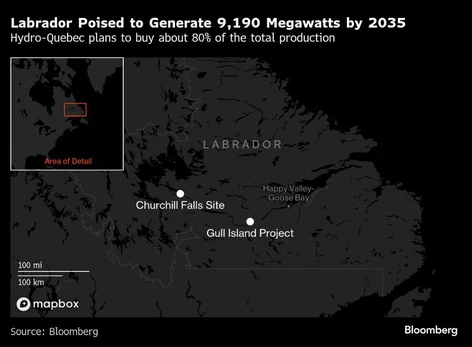
All together, the projects and transmission lines would cost over $25 billion, creating the second-largest hydroelectric complex in North America after Baie-James in northern Quebec. Hydro-Quebec, the utility owned by Canada’s second-most populous province, would cover the largest share of the costs and buy most of the output, thus increasing its supply from Newfoundland by 50 per cent to 7,200 megawatts.
Quebec Premier Francois Legault, who is himself a year away from an election, said in a post on X that his government is “fully committed” to continuing collaboration with Newfoundland. “I am convinced that the agreement in principle on Labrador energy development is beneficial to both Newfoundland and Labrador and Quebec,” he said.
Félicitations à Tony Wakeham pour son élection comme nouveau premier ministre de Terre-Neuve-et-Labrador.
Je suis convaincu que l’entente de principe sur le développement énergétique du Labrador est bénéfique tant pour Terre-Neuve-et-Labrador que pour le Québec.
Soyez assuré…
— François Legault (@francoislegault) October 15, 2025
The tentative agreement is part of Hydro-Quebec’s plan to invest as much as $200 billion to build new power-generation capacity and improve transmission reliability by 2035. The power utility holds a 34 per cent stake in Churchill Falls Labrador Corp. and would have a 40 per cent stake in the Gull Island project.
Bloomberg.com
Share This:






















INSIGHT: Canada’s Natural Resource Sector is at the Heart of the Government’s ‘Export & Diversification’ Plan