


 CDN NEWS |
  US NEWS







LNG Canada CEO Chris Cooper thinks Canada could become a top LNG exporter, UBC economist Werner Antweiler is skeptical
By Derrick Penner
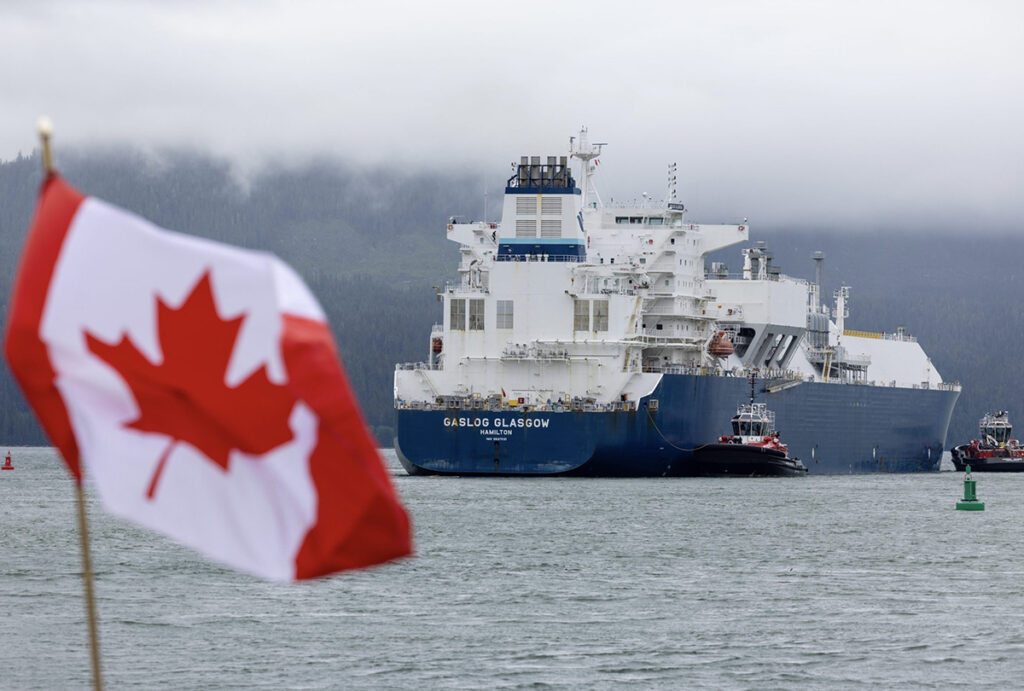
LNG Canada’s Kitimat natural gas liquefaction plant has barely begun exporting the super-chilled fuel, but the company’s CEO, on Wednesday, touted Canada’s potential to become a Top 5 global exporter if all the LNG projects on the books in B.C. go ahead.
The $18-billion LNG Canada facility shipped its first cargo of LNG June 30 at the end of a seven-year construction phase and CEO Chris Cooper said that, “In many respects, our timing couldn’t be better.”
Cooper said the world wants “high-quality, responsibly produced” energy, and Canadian LNG exports help Canada diversify trade at a time when the country desperately wants to do just that.”
Cooper added that the other projects on the books in B.C., including the Haisla First Nation-backed Cedar LNG under construction just south of LNG Canada, “will go a long way to help Canada achieve an even more ambitious but attainable goal to become a world energy superpower.”
That was a message that fit the moment for B.C. Premier David Eby, who was in Kitimaat to mark LNG Canada’s milestone and to offer $200 million in provincial support to the electrification of Cedar LNG’s operations.
Eby, on Tuesday, signed an agreement with the Haisla to support infrastructure for Cedar LNG, including a new power transmission line to the floating liquefaction plant the facility will use.
Wednesday, Eby used the occasion to position B.C. as a more reliable LNG trading partner, in addition to being more environmentally responsible, at a time “when we are under direct attack from the president of the United States with clear intentions to cause harm to our economy.”
Eby said B.C. received a warm welcome for LNG from this province on his recent trade mission to Asia, where the facility’s co-owners stated the importance of its reliability and environmental performance to customers on the world market.
In his remarks Tuesday, Eby said the U.S. looks like a riskier trading partner at the moment with Trump showing he will make “arbitrary and extrajudicial decisions on a whim,” announcing them through his own social media platform, Truth Social.


The premier declared that Canadian values will help Canada “win this race” to deliver LNG to Asia while Trump sets his sights on developing the industry in Alaska.
However, whether Canada is able to vault itself into the top tier of LNG exporting nations will likely be more a factor of timing and price than the country’s ambitions or environmental performance, according to trade economist Werner Antweiler.
The U.S. is now the world’s biggest LNG exporter, having shipped some 88 million tonnes of the fuel in 2024 followed by Australia at 81 million tonnes, Qatar at 77 million tonnes, Russia at 34 million tonnes and Malaysia at 28 million tonnes, according to the International Gas Union.
LNG Canada, with its initial phase, will produce 14 million tonnes of LNG per year, which would have put it at seventh on the International Gas Union’s list of exporters, about equal with Nigeria, which produced 13.8 million tonnes in 2024.
Existing projects under construction — Cedar LNG, Woodfibre LNG in Squamish, and FortisBC’s Tilbury plant — would raise B.C.’s production to just over 21 million tonnes, sixth on the list.
It would take final approval of the Nisga’a Nation-backed Ksi Lisims LNG and LNG Canada’s Phase 2 to put Canada into the Top 5, but Antweiler, a trade economist in the University of B.C.’s Sauder School of Business, said, “I don’t really see all of this materializing.”
Antweiler said the LNG market is competitive and the major producers are also working in other countries to snap up the long-term contracts they need to back projects in a market that the International Energy Agency is forecasting will flatten out after 2030.
“We’re also not the cheapest producer in this market,” Antweiler said about B.C., which is at a cost disadvantage to producers such as Australia and Qatar where the gas supplies are closer to ports where it can be liquefied and shipped.
“So we’re going to be a more marginal player and that means our position is much more vulnerable,” Antweiler said. “That’s the reason why I think that some of these projects just don’t compute at the end.”
With files from The Canadian Press
Share This:






















INSIGHT: Canada’s Natural Resource Sector is at the Heart of the Government’s ‘Export & Diversification’ Plan