


 CDN NEWS |
  US NEWS







By Jim Warren
France’s parliamentaryLeft are outraged. French populist, Marine Le Pen has had the unmitigated gall to suggest air conditioning (AC) saves lives during heat waves.
Le Pen’s party, Rassemblement National (RN) laid a bill before the French parliament in late June that if passed will require measures like “obligatory air conditioning for key public spaces,” such as hospitals and homes for the elderly. She is also concerned that public services in France “are unable to function because of a lack of air conditioning, unlike dozens of countries across the world”.
Research conducted by the medical journal, The Lancet, in 2019, suggests Le Pen and the RN are on to a good idea. The Lancet suggests that up to “195,000 heat-related deaths are averted annually by AC among people aged 65 or older globally.”
Yet, air conditioning is anathema to France’s parliamentary Left and the Greens. Neither do they care much for the Right-wing populists in Le Pen’s party.
According to a July 3 news item on the online news site, UnHerd, “The RN’s plans came under attack from the Left and the French Government. Leader of the Greens, Marine Tondelier, mocked Le Pen for making AC the focal point of her environmental policies.”
UnHerd reported government ministers also ridiculed “Le Pen’s new found interest in climate politics and were concerned by the environmental footprint of AC.”
The Left and the Greens similarly claim air conditioning has an egregiously high environmental footprint, principally because it “wastes” so much electricity. They underline the fact that much of the electricity consumed globally is produced using coal and natural gas. Environmental purists contend the emissions thereby produced are the cause of global warming and recent heat waves.
They also believe cooling people off with AC (to prevent heat exhaustion) will lower their interest in reducing greenhouse gas (GHG) emissions. The Greens and the Left reason heat-stressed people might ask why they should spend more on an expensive green transition if they can avoid death from heatstroke by turning on the AC?
French anti-emissions activists extremists argue heat stress is no big deal. To avoid it just close your windows in the daytime, cover vents with damp towels and stay hydrated. Unfortunately, it’s too late for them to pass those bits of surefire good advice onto the 14,800 French people who died due to high temperatures during the European heat wave of 2003.
It is as though the Greens and the Left want people to sweat and suffer as penance for using fossil fuels over the past two centuries. We’ve been very bad and deserve to wear hair shirts until we reach net zero emissions.
What makes the anti-AC position of the French Left so monumentally bizarre is the fact France is a world leader in low emissions electricity production. France’s fleet of 56 nuclear reactors account for 71.67% of its total electrical power production—and nuclear has about as low a GHG emissions footprint as it gets. Table 1 below shows the three principal sources of energy used for the production of electricity in France. Table 2 provides an overview of overall French energy consumption.
Incidentally, France is not currently short of electricity. In recent years it has been selling surplus electricity to some of its EU neighbours – apparently at discounts that don’t cover the cost of production. There appears to be enough electricity available to increase the use of air conditioners. Furthermore, construction on the 57th reactor for the French nuclear power fleet should be completed soon, adding to France’s relatively emissions free generating capacity.
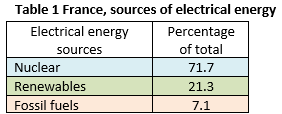
Sources—derived from Our World in Data. Energy consumption by source, France
https://ourworldindata.org/grapher/energy-consumption-by-source-and-country?country=~FRA and
Wikipedia Electricity Sector in France https://en.wikipedia.org/wiki/Electricity_sector_in_France


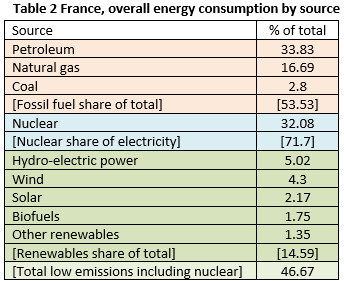
Source—derived from: Our World in Data. Energy consumption by source, France
https://ourworldindata.org/grapher/energy-consumption-by-source-and-country?country=~FRA
Different heat-strokes for different folks – adaptation versus emissions reduction
With some exceptions, such as the government buildings where France’s political and bureaucratic elite do business and the homes of the wealthy, air conditioning isn’t all that common in France. This seems ironic given that large swathes of the French elderly and poor populations have proven highly vulnerable to heat waves. The deaths of those 14,800 people in France in 2003 occurred primarily among the elderly and the poor.
The French Greens have their hearts set on geothermal and organic cooling. They support measures such as planting large numbers of trees in urban neighbouhoods. The transpiration from trees has a cooling effect, as does the shade they provide. One problem for many of the vulnerable elderly is they won’t live long enough to sit under the shade of trees planted today. Ideas such as geothermal heating and cooling are interesting, and being applied in places, but we are still a long way from perfecting the technology for commercially viable mass application.
As is the case with many extreme climate events, the green Left and the media claim virtually all hot days and heat waves are “record setting” and “attributable to GHG emissions.” This, like other claims made by environmentalists and the media, isn’t entirely correct.
For instance, the jury is still out on whether the European heat wave of 2003 surpassed the all-time historical record. There are paleoclimatologists and historians whose research suggests the year 1540 may have been hotter. That heat wave occurred approximately 310 years prior to the surge in coal consumption and CO2 emissions associated with the maturing of the Industrial Revolution. And it was 380 years prior to the widespread adoption of internal combustion engines. No less surprising is the fact the 1540 heat wave occurred during what is referred to as the Little Ice Age.
Another factor contributing to heat-related deaths in France in 2003, is that not enough urban dwellers were sufficiently concerned about the elderly, shut-ins and the homeless to check on them and get them to cool places. Of course, finding a cool place was challenging in 2003 because there were few publicly available cooling stations.
France’s virtuous bicycling Bolsheviks don’t accept the charge that they don’t care enough about their elderly neighbours and are content to let them die before supporting AC. The Left and the Greens assume they are much too virtuous to be the cause of anything bad. After all, the environmental Left have been working hard, applying for government grants and attending anti-oil and coal demonstrations for years. Indeed, some of the same people were rabid anti-nuclear protesters prior to discovering global warming.
The ambitious cooling plan advanced by the Rassemblement National will require the installation of AC systems in schools, hospitals, retirement homes and other public buildings. Their plans align well with proposals advanced by policy analysts who embrace adaptation as a vital response to climate hazards.
The adaptation perspective does raise the hackles of environmental purists who want countries to focus most, if not all, their climate attention on cutting CO2 and methane emissions as opposed to learning how to prepare for and cope with climate change. Adapters embrace strategies like setting up public cooling stations in communities which experience high temperatures and lack air-conditioned housing and workplaces.
Climate science suggests regardless of what happens with GHG emissions reduction in the short term, a certain amount of additional warming is already baked into the global climate system. This means we could go to net zero emissions tomorrow and still see temperatures rise and remain high for decades to come. If those projections are correct, failing to adopt reasonable adaptive measures doesn’t makes a lot of sense.
Even retired mobsters living in Florida see the wisdom of adapting to changing climate conditions. Floridians build sea walls to reduce storm surge damage.
Of course many of us out here on the Great Flatness are all for emissions reduction measures when they involve nuclear power generation. Saskatchewan is the world’s second largest producer of uranium.
Whether or not climate change alarmism is justifiable, it has been good for uranium prices. Saskatchewan yellow cake (U308) spiked at a spot price just over $100.00 CAD per pound in January 2024, and we can produce around 30 million pounds of the stuff each year. As of July 8, 2025 it was down to just $79 CAD per lb. While Saskatoon-headquartered Cameco is the biggest player in Saskatchewan’s uranium patch and at least one French-owned company, Orano Canada, is invested in uranium mining and milling in the province.
-30-
Share This:






















INSIGHT: Canada’s Natural Resource Sector is at the Heart of the Government’s ‘Export & Diversification’ Plan