


 CDN NEWS |
  US NEWS









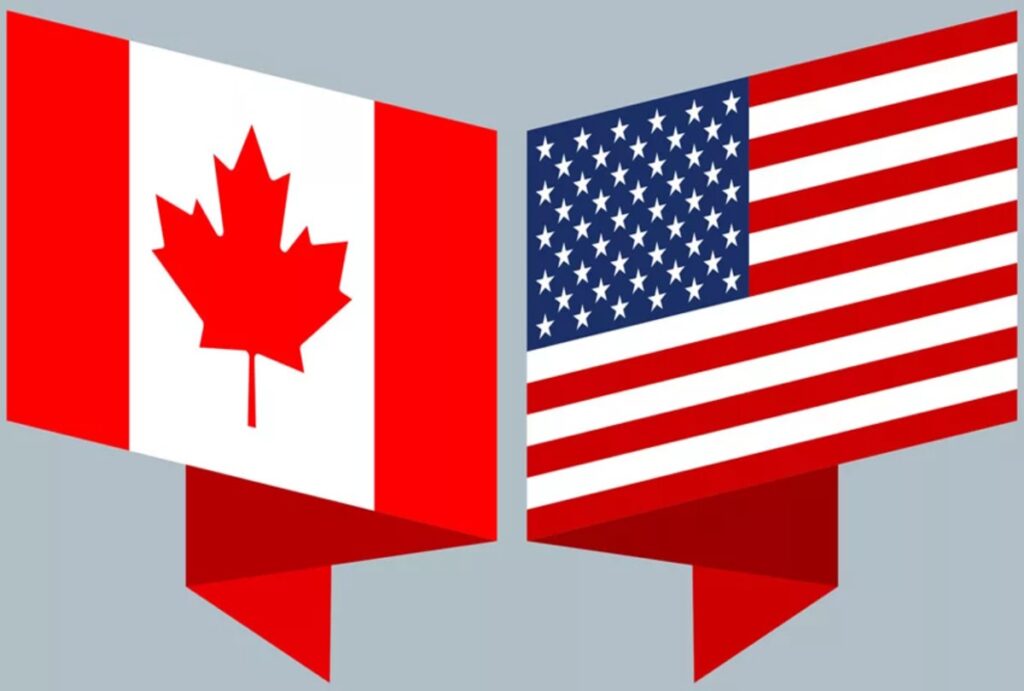
“My country, right or wrong; if right, to be kept right; and if wrong, to be set right.”—Carl Shurz, U.S. citizen and U.S. Senator who immigrated from Germany
Introduction
I was born in, and grew up in, Manitoba. I earned my undergraduate degree at the University of Winnipeg and two years later, at age 21, moved to the United States to earn my PhD in economics. I got my green card in 1977 and became a U.S. citizen in 1986, while keeping my Canadian citizenship.
You might think, given President Donald Trump’s harsh treatment of Canada, a traditional and loyal ally, that my loyalties are torn. On the one hand, I’m a Canadian citizen who still loves Canada and the important principles about freedom and government that I learned while growing up in Canada. On the other hand, I’m an American citizen who still loves the U.S. and the important principles I learned while studying economics, learning the American traditions that support freedom, and learning about and treasuring the U.S. Constitution.
I’m not torn.
The reason is that there’s no contradiction between the principles I learned in Canada and the principles I’ve learned in the U.S. Growing up in Canada, I learned about our heritage of liberty, mainly from Britain. As an adult in the U.S., I added to that knowledge, both by learning about the views of the Founding Fathers and by reading the details of the U.S. Constitution. When I took an oath to become a U.S. citizen, I promised to “support and defend the Constitution and laws of the United States against all enemies, foreign and domestic.”
I take that oath seriously.
The U.S. Constitution is a beautiful mixture of checks and balances. The Bill of Rights is, of course, a check on government power. But other parts of the Constitution are a check also. Libertarian scholar Tom Palmer has pointed out that the Constitution enumerates the powers of each branch of the federal government. As I put it in a 2007 talk on Constitution Day, September 17, “If the federal government does not have a specific power granted to it within the Constitution, then it does not have that power. Period. The Ninth and Tenth Amendments assure that. The U.S. Constitution is a set of enumerated powers.”
What’s particularly relevant is that the U.S. president has no power to set tariffs—that’ power belongs only to the U.S. Congress. That means that President Trump is violating the U.S. Constitution and, incidentally, his oath of office. Some pundits argue that Trump does have that power because the U.S. Congress, in a 1977 law, granted him that power. That’s false. The only way the president can get new power—that’s not granted to him in the Constitution—is through a constitutional amendment. There’s a well-defined process for amending the Constitution. That has not been done.
Those are my thoughts as a loyal U.S. citizen. But they are not my only thoughts on this issue. I also have thoughts as an economist.

The Economics of Trade and Tariffs
I want better for the U.S. and Canada and, indeed, for the rest of the world. One of the surest ways for people in various countries to be better off is to have free trade. Free trade is good for both sides, or else people wouldn’t engage in it. Free trade gives people an incentive to produce the goods and services for which they are the lowest cost producers and then to buy goods and services from people who are the lowest cost producers of those other goods and services. That’s why Californians buy wheat and corn from Iowa rather than California. The principles don’t change when a national border separates trading partners. People in the U.S. have a cost advantage in producing complex airplane parts and people in Vietnam have a cost advantage in producing clothing.
In the 19th century through to the 1940s, the U.S. had high tariffs. In the 1930s, spurred in part by the Smoot-Hawley Tariff Act of 1930, there was an international trade war. Consequently, in 1934 the average tariff rate worldwide hit 22 per cent. But after the Second World War, there were various negotiating rounds where the U.S. cut its tariff rates and other countries cut theirs. By 1999, that average rate had hit 4 per cent. That’s not free trade, but it’s close.
Because of trade, people around the world are better off than they would have been if trade had been highly restricted. We have access to cheaper goods and higher-quality goods with more variety. Go to any wine store, for example, and you can see the incredible variety due in large part to the presence of wines from around the world.
One further advantage of trade is that countries that trade with each other are more likely to have peaceful relations with each other. French political philosopher Montesquieu, whom many of America’s founding fathers read closely, put it well: peace is “a natural effect of trade.” It’s not a sure thing; the big counterexample is the First World War, which occurred well after trade among England, France and Germany had blossomed. Nevertheless, trade makes peace more likely. In a 2006 article, economists Solomon W. Polachek and Carlos Seiglie reported that a doubling of trade leads to a 20 per cent decrease in belligerence.
The Effects of Donald Trump
Now into this situation appears Donald Trump. Trump has claimed powers to unilaterally set tariffs. The U.S. Constitution does not give him these powers, but that hasn’t stopped him. Like many presidents before him, Trump has not kept his oath to “preserve, protect, and defend the Constitution.”
Trump keeps changing his mind, but a reasonable bet is that when the dust settles, the average tariff rate the U.S. government imposes on imports from other countries will be at least 10 per cent. In 2024, before Trump was inaugurated, the average U.S. tariff rate was 3.3 per cent. Other countries, including Canada, may also have higher tariff rates than they had just a few months ago.
Here’s how I put it in a February 20, 2025 article titled “The Benefits of Free Trade Are at Risk:”
One of the most important gains in economic freedom since World War II has been the worldwide reduction in tariff rates. It took years of negotiation to achieve that result. It would be a tragedy if Trump blew it.
Conclusion
The relationship between the United States and Canada has been one of the best relationships in world history. For more than two centuries there has been peace between the two countries. (Although Canada did not become a country until 1867, I’m regarding the British colonies in Canada before 1867 as Canada.) And not just peace, but truly cordial relations.
Donald Trump has put all of that at risk. He’s now taunted two Canadian prime ministers about making Canada into a 51st state. He seems to think he’s clever. He’s not; he’s just rude. We Canadians and Americans should think long term and not let this man distort the feelings of friendship between the two countries. We’re better than that.
Share This:























THE GEOTHERMAL OPTION: B.C.’s Overlooked Firm Power Option: What the Geothermal Evidence Shows – Resource Works