CDN NEWS |
  US NEWS







By Jake Fuss and Grady Munro
As part of his successful election campaign, Prime Minister Mark Carney promised a “very different approach” to fiscal policy than that of the Trudeau government. But when you peel back the rhetoric and look at his plan for deficits and debt, things begin to look eerily similar—if not worse.
The Carney government’s “responsible” new approach is centered around the idea of “spending less” in order to “invest more.” The government plans to separate spending into two budgets: the operating budget (which appears to include bureaucrat salaries, cash transfers and benefits) and the capital budget (which includes any spending that “builds an asset”). The government plans to balance the operating budget by 2028/29 (meaning operating spending will be fully covered by revenues) while funding the capital budget through borrowing.
Aside from the fact that this clearly complicates federal finances, this “very different” approach to spending actually represents more of the same by continuing to pursue endless borrowing and a larger role for the government in the economy.
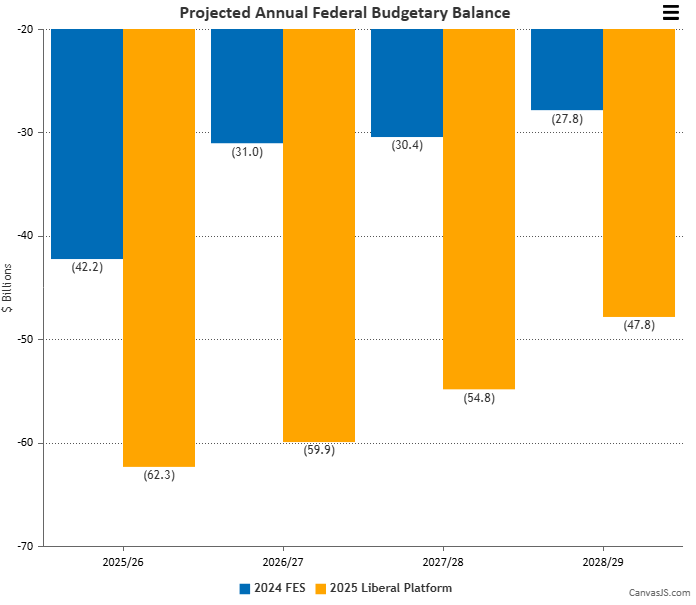
The chart below compares projected annual federal budget balances for the next four years, from both the 2024 Fall Economic Statement (FES)—the Trudeau government’s last fiscal update—and the 2025 Liberal Party platform. Importantly, deficits from the 2025 platform show the overall budget balance including both operating and capital spending.



Let’s start with the similarities.
In its final fiscal update last fall, the Trudeau government planned to borrow tens of billions of dollars each year to fund annual spending, with no end in sight. Based on its election platform, the Carney government also plans to run multi-billion-dollar deficits each year with no plan to balance the overall budget. The only difference, despite all the rhetoric regarding change and Prime Minister Carney’s criticism of the Trudeau government’s fiscal approach, is that the Carney government plans to run larger deficits and borrow more money.
In the current fiscal year (2025/26) the Trudeau government had planned to run a $42.2 billion deficit. The Carney government now plans to increase that deficit to $62.3 billion. Trudeau’s most recent fiscal plan forecasted annual deficits from 2025/26 to 2028/29 representing a cumulative $131.4 billion in federal government borrowing. Over that same period, the Carney government now plans to borrow a cumulative $224.8 billion.
The Carney government’s fiscal plan does include a number of tax changes that are expected to lower revenues in years to come—including (but not limited to) a personal income tax cut, the elimination of the GST for some first-time homebuyers, and the cancelling of the planned capital gains tax hike. But even if you exclude these factors from the overall budget, the Carney government still plans to borrow $52.9 billion more than the Trudeau government had planned over the next four years.
By continuing (if not worsening) this same approach of endless borrowing and rising debt, the Carney government will impose real costs on Canadians. Indeed, 16-year-olds can already expect to pay an additional $29,663 in personal income taxes over their lifetime as a result of debt accumulation under the previous federal government, before accounting for the promised increases.
One of the key promises made by Prime Minister Carney is that his government will take a different approach to fiscal policy than his predecessor. While we won’t know for certain until the new government releases its first budget, it appears this approach will continue the same costly habits of endless borrowing and rising debt.
Share This: