CDN NEWS |
  US NEWS









Also: Canadian officials are planning a meeting with US banks

Drill, Baby, Drill
Washington’s trade war has opened the door, politically, to a quick expansion of Canada’s oil, gas and mineral production. Bank CEOs are determined to make the most of it.
The message from Bay Street’s leaders has been loud and clear in recent months: for Canada to control its fate in the Trumpian world order, the country needs to exploit its resources like never before.
“We cannot fall back to where we were as a country,” Dave McKay said at Royal Bank of Canada’s annual meeting on Thursday. He lamented the government’s track record of punitive taxes, barriers to project approvals, bureaucracy and even a lack of ambition to “do some big things.”
“There is so much opportunity in this country in front of us that we have failed to seize as a nation,” he said, urging his audience to vote for a political party that will bring “prosperity and inclusivity.” (He did not endorse any party, of course.)
The country “needs a growth-first agenda,” Bank of Nova Scotia’s Scott Thomson said at his bank’s AGM, and that means “unlocking Canada’s natural resources,” producing more critical minerals and natural gas and building energy infrastructure.
“We need to treat this as a burning platform in Canada to address some of the deficiencies over the last 10 years,” he told me in an interview.
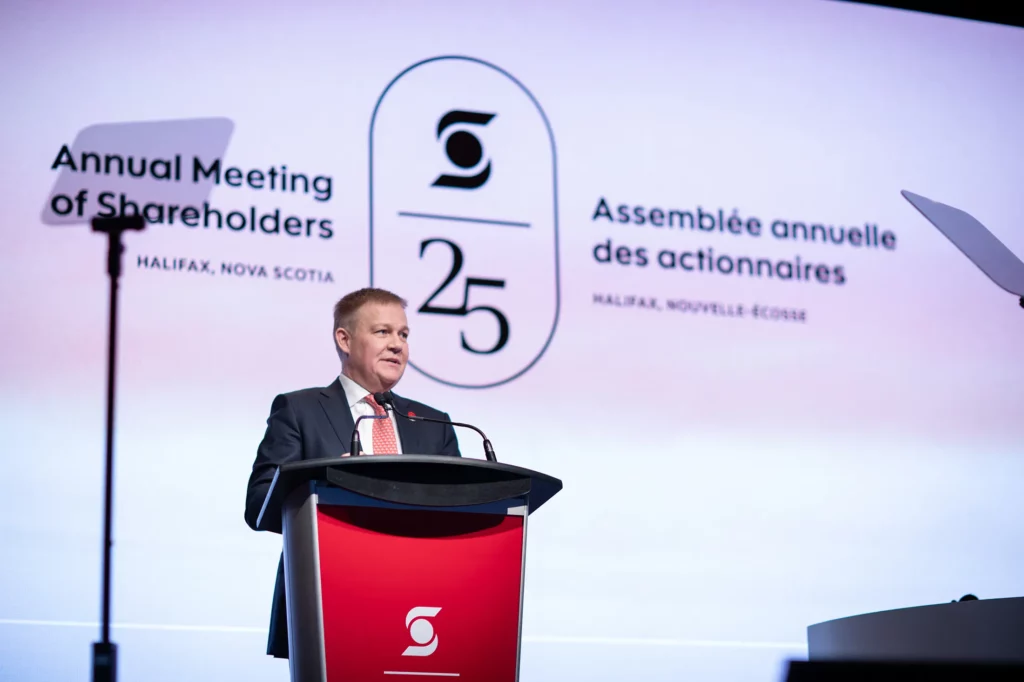
Scotiabank CEO Scott Thomson said Canada is facing an “existential challenge” and needs to pursue a “growth-first agenda.” Source: Bank of Nova Scotia
Other bank CEOs, including Bank of Montreal’s Darryl White, National Bank’s Laurent Ferreira and CIBC’s Victor Dodig, have also been playing that tune.
“The business community can help change the growing narrative about Canada being a difficult place to get big things done,” White said in a speech at the bank’s AGM Friday morning, adding that investors and developers need more predictable and faster regulatory approvals.

Dodig’s prescription for “the great Canadian comeback” takes aim at Trudeau-era policies such as Bill C-69, which brought in the Impact Assessment Act, a law that has been derided by investors for wrapping projects in red tape.
“The current layering of decisions is an anvil to progress, holding us back and costing us dearly economically and in our standing in the world,” Dodig said.
It’s all starting to sound like a Canadian version of “drill, baby, drill,” and it’s a shift from a year ago, when bank CEOs were still padding their speeches with paragraphs about how they’re responding to climate change.
And they have a receptive audience in the country’s two major political parties, whose leaders are trying to convince Canadians they’re best to handle the economy and the trade war in an election campaign in which few other issues matter.
The Liberals’ Mark Carney and Pierre Poilievre of the Conservatives have both pledged to streamline major energy project approvals, with similar-sounding proposals to create “one project, one review” systems. Carney’s 2021 book, Values, is filled with references to “net zero” and the transition to cleaner forms of energy. But he’s not spending much time talking about those concepts now.
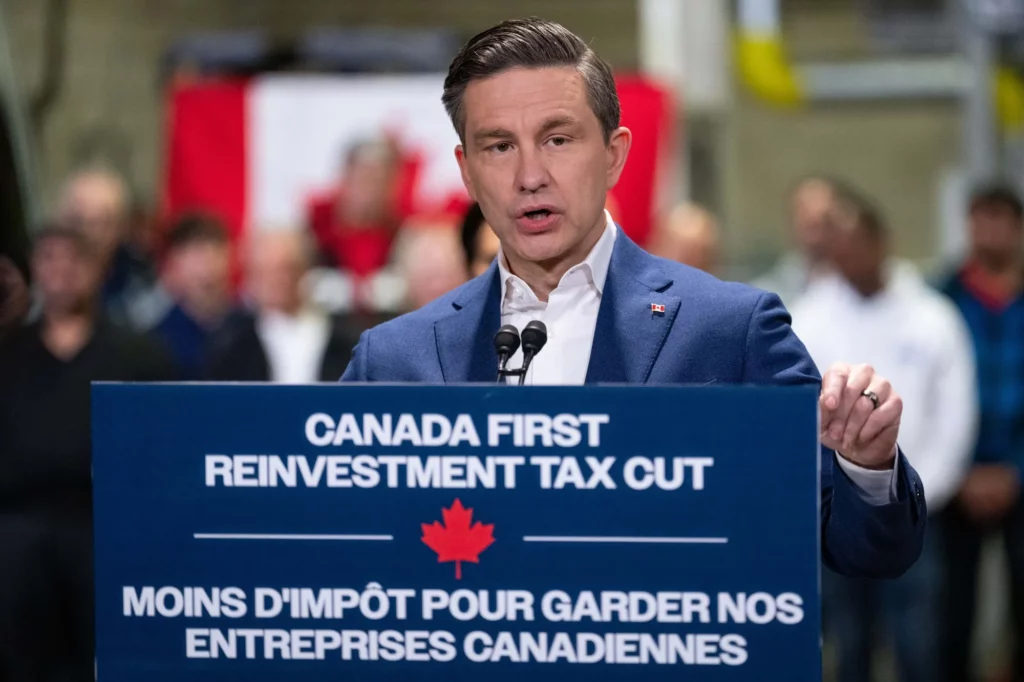
Pierre Poilievre, leader of Canada’s Conservative Party, has said he would repeal Bill C-69, the Impact Assessment Act. Photographer: Arlyn McAdorey/Bloomberg
The call to build pipelines, approve liquefied natural gas projects, and dig up and export critical minerals still faces numerous opponents and critics, many of whom still want the banks to curb their role in financing resource projects.
A group of climate activists and Indigenous elders protested at RBC’s meeting for the fourth year in a row, raising concerns about the environmental impact of fossil fuel projects backed by the lender.
Activists have also targeted BMO this year, calling on it to end a partnership with the Canadian Association of Petroleum Producers. The bank co-hosted an energy symposium with CAPP this week in Toronto.
Canada’s banks all say they’re still committed to reaching net-zero carbon emissions in their lending activities by 2050. They’re earmarking more money for renewable energy projects but they won’t back away from financing fossil fuels and, they say, helping their clients transition to the new, lower-carbon world.
And now, as the debate about Canada’s economic future moves ahead, bank CEOs are the new — very vocal — champions of natural resource development.
Share This: