


 CDN NEWS |
  US NEWS







August 15, 2022
With oil and gas prices rising because of supply shortages and disruptions, the world is again rediscovering the existence and importance of the oilfield services (OFS) industry.
OFS was a huge casualty as producers cut spending to the bone to survive the past seven years. The oil services sector is back in the news because of capacity limitations, labor shortages and investment potential.
The largest obstacle to increasing oil and gas production right now is finite OFS capacity.
This is a good time to better understand how big OFS is, its symbiotic relationship with producers, and how much collateral damage policy makers create when they change the rules for oil and gas developers.
The oilfield support sector could be the largest essential but misunderstood business in the world.
OFS has always been the poor cousin of exploration and production (E&P) companies.
The primary focus of politicians and the public has always been the nationality, size, purpose, motives and future of oil producers and production. As providers of the energy and products that have shaped modern civilization, E&P companies are the subject of continuous advice, analysis, legislation, regulation, speculation, protection and attack.
Soldiering on one layer down is OFS, the massive but poorly understood collection of services, supplies, equipment and labor necessary to extract oil and gas from the ground, and turn them into money and essential products for industry and consumers.
Unless you’re in the business, OFS is taken for granted or ignored. Reams of financial and market research and analysis is conducted for specific OFS segments and companies. But not enough macro-economic study is performed to understand how big it is or how many people, companies and products are involved.
It starts with the size of the global oil and gas production industry that OFS serves.
Based on 100 million barrels per day of output, the world produces 36.5 billion barrels annually. At US$95 a barrel this generates annualized revenue of US$3.5 trillion.
Natural gas is more complicated because it is moved by pipelines or consumed at or near the wellhead. Data source www.worldometers.info publishes a gas production figure for 97 countries that totals 154 trillion cubic feet per year, or 423 billion cubic feet per day. At US$7 per thousand cubic feet, this equates to annual revenue of US$1.1 trillion.
Considering current gas prices in Europe and Asia, this is a low figure. But 2022 is a very unusual year.
The total is US$4.6 trillion. Using World Bank data, this figure is about 5% of global GDP. But this doesn’t include transportation, processing, refining and distribution.
What portion goes to OFS?
This is complicated. There are two elements of production revenue that flow to OFS. They are operating costs, or OPEX, and capital expenditures, or CAPEX. Where do producers spend their money? How much is done internally? How much is outsourced?
A sample of the financial reports for several Canadian and American producers reveal that in the first six months of 2022, direct production costs, or OPEX, averaged 13% of revenue. Applied to global revenue, this would total US$582 billion.
In the Statement of Cash Flows under “expenditures on property, plant and equipment” – CAPEX – the average was 12% of revenue. The extrapolated global figure US$550 billion. This is significantly lower than historical spending before 2015.
Assuming all OPEX and CAPEX flows to OFS, this equates to a US$1.1 trillion annualized industry.
OPEX is spread between company and third-party assets, vendors and personnel. It depends on who owns the field processing facilities and whether the field staff are employees or contractors. But all the service work and operating supplies come from OFS. E&P financial statements provide no details on the composition of production/operating expenditures.
CAPEX is easier to understand. The International Energy Agency tracks global CAPEX on new supplies of oil and gas. Investment peaked in 2014 at US$780 billion but declined almost steadily until 2021.
International research firm Rystad Energy issued a report on June 21 which estimated that “legacy” OFS companies in drilling and completion could see revenues of “…US$395 billion in 2022-2023. Out of the total $395 billion in the current two-year period, around US$150 billion will be spent on well intervention and production-related services, and the remainder on drilling and reservoir evaluation-related services.”
But these are just the western publicly traded companies directly related to exploration, wellbore construction, completion and production services. The good news is that the Rystad data underpins about 20% of the above estimated CAPEX arrived at in an entirely different way.
As a cross reference to IEA data, let’s look at the 2014 revenues from the largest publicly traded multi-national well-known OFS giants. The combined revenue for Schlumberger, Halliburton, Baker Hughes, Weatherford, Nabors, TransOcean, China Oilfield Services, and Petrofrac that year was US$150 billion.
Based on the IEA’s total, who got the other US$630 billion? What equipment, services, supplies and personnel are used on the ground in place like China or now Russia (with western OFS pulling out) is difficult to quantify. Who keeps the wells producing and replaces reservoir declines in Libya, Venezuela or Iran these days?
Further complicating this analysis is that companies like Schlumberger, Halliburton, Baker Hughes and Weatherford generate a significant portion revenue from production support, or OPEX. They report revenue by region and product line, not OPEX or CAPEX.
Using the IEA data and production and average commodity prices for 2014, CAPEX was 21% of revenue, nearly double today’s levels percentage wise. The IEA figures that to sustain production upstream investment should be as high as US$1 trillion annually. Using the above model, that would raise the OFS sector to over US$1.5 trillion.
Is transportation not OPEX? Should midstream be considered OFS? Are tankers not floating pipelines?
In the US alone, www.investing.com reports the 10 largest pipeline operators had annual combined revenues of US$193 billion from Energy Transfer, Plains, Enterprise, NGL, Kinder Morgan, ONEOK, Targa, Williams, DCP and EnLink.
If some of these companies do field processing including wastewater treatment and disposal, is that not OFS? Canada’s Secure Energy Services, the leader in oilfield waste management, is classified as an oilfield service company.
Canadian pipeline operators Enbridge, TC Energy and Pembina Pipeline had combined revenue of $65 billion in 2021. Enbridge and TC are expanding outside of Canada out of economic necessity. Should their revenue and economic impact not be captured when postulating about the future of oil and gas?
Canadian producers CNRL, Tourmaline and Whitecap report transportation costs as a line item on the income statement. For oil sands producer CNRL the expense reads “transportation, blending and feedstock.” For the first six months of 2022 this expense was 19% higher than “production”. For Tourmaline “transportation” was 17% higher than “operating”. No notes in the financial statements provide details.
How much of this is OFS? How much should it be?



When I was on the board of the Petroleum Services Association of Canada from 2006 to 2011 and Chairman in 2009/10, we had lively debates about the definition of what should be classified as OFS. It was generally accepted that pipelines weren’t OFS until the representative from Mullen Trucking Corp. described their oil hauling division as a “pipeline on wheels.”
Trucking oil is a growing business in North America because of high decline rates for new oil wells. Often tying in wells and batteries with pipe isn’t economic. Further, the regulatory nightmare associated with getting new pipelines approved makes trucking faster and simpler.
Hauling frac fluids and other stimulation chemicals to the field is definitely OFS. If the same equipment hauls away oil is that transportation, or OFS?
Then there’s crude by rail. Should Canadian Pacific and Canadian National be considered OFS companies? It has been big business at peak levels. In February 2020 it peaked at 412,000 b/d before it fell off a cliff due to the pandemic lockdown. In the first five months of 2022 crude-by-rail averaged 145,000 b/d.
America’s EIA says it costs an average of US$10 to US$15 to ship a barrel of oil by rail. Using the high figure because of the distance from Canada to the Gulf of Mexico and based on 2022 data, that’s another billion dollars a year in what could be classified as OFS spending that is buried somewhere in E&P financial statements.
The railways also transport refined products like gasoline, diesel and propane. Is this not a pipeline on tracks?
As PSAC Chair I quarterbacked a study of the Canadian OFS industry to try to figure out how big OFS was. In trying to understand the bigger picture, it included transportation but left out gas plants and refineries.
The purpose of the research was the continuing economic vacuum in which Canadian energy policy is written. It is always focused on E&P profits and voters politics, but routinely ignores the hundreds of thousands of people and thousands of companies involved in the massive oil and gas supply and support chain.
This first became obvious during the National Energy Program in 1980. When the Liberal government of the day was advised of the large number of drilling rigs fleeing to the US because of their policies, the government responded, “Are those oil rigs or gas rigs? We don’t need gas rigs. We have lots of gas.”
Twenty-seven years later – in Alberta of all places – the Ed Stelmach Progressive Conservative administration introduced the New Royalty Framework which jacked up production royalties in pursuit of a “fair share” of oil and gas revenues. This was done in a booming economy in the middle of a spectacular oil boom, and conceived by a provincial government collecting so much cash it had to invent new ways to spend the money.
Stelmach’s administration seemed genuinely perplexed when capital and equipment fled the province and the hotels and restaurants across Alberta began to empty.
So that’s where the oil money goes! It’s not just oil company fat cats driving Ferraris.
The New Royalty Framework, and Stelmach’s political career, ended shortly thereafter.
Working with the Canadian Energy Research Institute, PSAC used the Statistics Canada Input/Output GDP model to go down the entire E&P supply chain well beyond the better understood direct players of drilling and service rigs, wireline trucks, pumping services and OCTG mills. At that time it had to include all the input components for multiple massive oil sands construction projects. It also contained a survey among Canadian OFS operators about the size of their international operations.
Using this methodology Canadian OFS was 4.8% of Canada’s GDP and was the second largest private sector industry in the country behind only oil and gas production.
This analysis was first rejected, but later accepted, by the federal and Alberta government. Statistics Canada still uses antiquated data categories that have not been modified as Canada’s oil business grew to national and international importance. This lack of good data leads to terrible public policy decisions.
StatsCan remains the primary source for Alberta’s employment reporting. The monthly macro-economic jobs report is titled Alberta Labor Force Statistics. Oil and gas falls under the broad bucket of “Forestry, fishing, mining, oil and gas.” For July 2022 this accounted for only 5.9% of the total jobs in the province.
Perhaps that’s because Alberta’s fishing and forestry sectors have been devasted by climate change. Or because Alberta has no oceans and much of the province has no trees.
When people push for the decarbonization of Alberta’s economy to save the world, they look at this employment data and wonder what all the fuss is about. Who needs the oil industry? Why can’t Albertans simply do something else like install solar panels or wind turbines?
But there are nearly three times as many jobs in utilities, construction and manufacturing. Many oil-related companies and jobs exist in these sectors.
And there is significant oilpatch support activity in the five other job buckets of trade; transportation and warehousing; finance, insurance, real estate and leasing; professional, scientific and technical services; or business, building and other support services. These account for 38% of Alberta’s total employment.
There are hundreds of companies with thousands of employees that support the oilpatch in these employment categories.
But because of the way StatsCan collects and reports data, these oil industry jobs don’t exist.
Because of climate change and the energy transition, not only must the oil and gas business go but OFS and the rest of the support sector is a regrettable but necessary casualty.
Decarbonization policies are invented and supported by urban Canadians who have no idea where anything comes from, let alone oil and gas. This is greatly assisted by an information vacuum on the enormity of the support industry, domestically and globally.
As Canadian governments have learned – and are learning again as the oil industry recovers – there are a lot of jobs and economic activity associated with oil and gas production from businesses that don’t produce either.
OFS will never outperform its customers. It’s the nature of the business.
But climate-driven employment transition policies like the Just Transition are Just Insanity without some basic understanding of how the oil business works.
We can and must do better, and it begins with better data.
And we should start right here in Alberta.
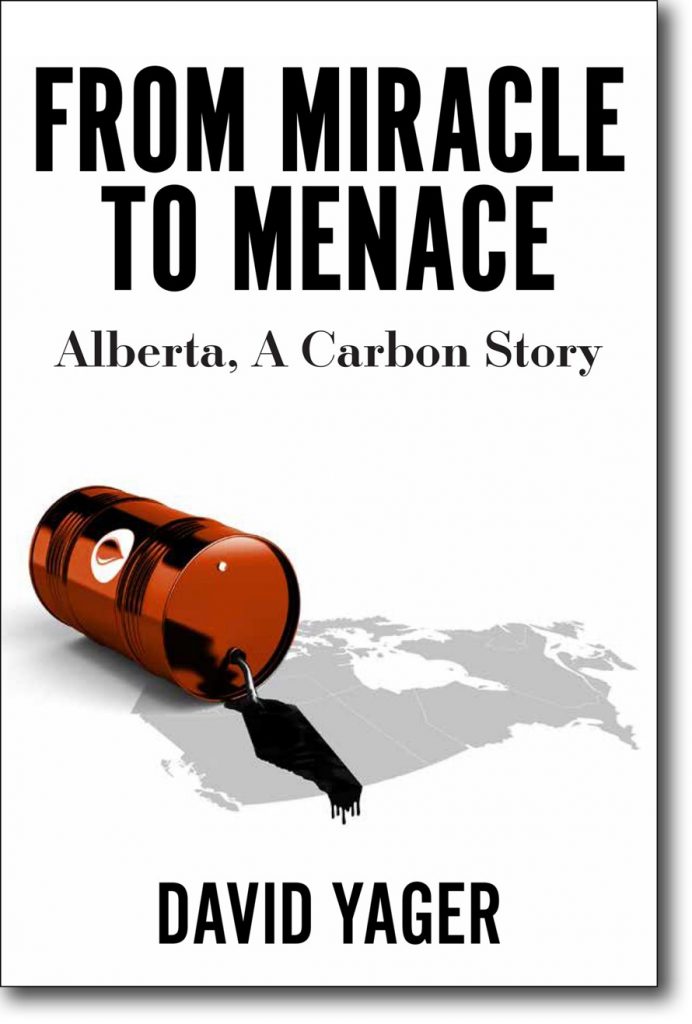
David Yager is an oil service executive, oil and gas writer, energy policy analyst, and author of From Miracle to Menace – Alberta, A Carbon Story. Find the book to www.miracletomenace.ca. He is President and CEO of Winterhawk Well Abandonment Ltd. which has commercialized a new casing expansion technology for improving annular wellbore integrity.
Share This:






















INSIGHT: Canada’s Economy Falling Behind Despite Misleading Headlines – Fraser Insitute